WP4- On the Lisbon Treaty

Hereby the first DRAFT release (V.1.6) of the Working Paper 4 on the Lisbon Treaty, defining the European Union.  The first document is a short summary on the difference between intentions and practice of the Lisbon. The second document is an extensive analysis of the Lisbon treaty.

English version:

WP4-summary-Lisbon intentions_EN

WP4_OnLisbon_Feb25_EN_V1-6

Dutch (Nederlands) versie:

WP4-summary-Lisbon intentions_NL

WP4_OnLisbon_Feb25_NL_v1-6

Summary: Why the Lisbon treaty is not final

The European Union has always followed a path of successive changes, often triggered by a passage through crisis, be it internally or because of the geopolitical context. Each time, inadequacies came to light and new treaties were ratified or existing treaties were amended.

Firstly, the last treaty, i.e. the Lisbon treaty followed a curious path. Originally meant as a new treaty, the Constitution of the European Union, it was replaced by a new treaty in the form of an extensive list of amendments to existing treaties. This path is worrisome as it undermined the democratic legality of it, even if arguments can be raised that it was a necessity long overdue. It did not help in getting citizens’ support, which is a long-term risk that is currently emerging.

Secondly, the treaty was meant to increase the democratic process in Europe but this largely failed in practice. National as well as the EU parlements, even if they are the official legislative powers, largely rubberstamp the Commission’s proposals and directives. Very seldomly are these challenged. The reasons are not so much the treaty itself but the fact that the real power is under control of political parties and the nation’s executive powers. It should be noted that this reflect very often the situation at national level which is projected at the EU level. In both cases, the members of parliament who are supposed to represent the citizens, do not act on behalf of the citizens but on behalf of political parties and the power structures behind them. And as was pointed out, this undermining of democratic principles is reinforced by a salient majority that has intruded the institutions and media. In addition, lobbying by strong groups and organisations heavily influences the decision-making processes. The Lisbon treaty does not seem to have anticipated these democracy undermining actors.

Thirdly, the Lisbon treaty transferred many competences from the national to the European level. It allowed the EU to impose stringent measures on all member states during the Covid epidemic, stringent CO2 emission obligations, a counter-productive energy policy and an avalanche of regulations in many domains that impact on the industry but also on citizens’ daily life. It is questionable if these grand schemes like the “Green Deal” would ever have materialised if a real democratic decision process would have been in place. Practice has also shown that the treaty did not establish clear boundaries between competences at the national and supra-national level. This weakness was exploited to impose many regulations from the top, often ignoring that the EU is composed of a heterogenous set of nation states.

Fourthly, the Lisbon treaty did no establish a structure that would have allowed the EU to act as a strong unified block at the supra-national level. While some steps were taken, in practice the EU still acts as a weak, opportunistic collection of national states and heads of state, while important decisions can still be blocked by a single member state. This concerns domains like defence, international politics, economic policies and innovation strategy.

And last but not least, if one looks at what the EU in Europe achieved in the last 20 years, then it is clear that the treaty was fraught with wishful thinking. The position of the EU in the world has been shrinking economically as well as politically and continues to do so. The EU is known for its high level of social security programs, taxes, regulations and quality of education. These are increasingly financed by debt whereas the economy is shrinking and hence the export balance is not generating the means to finance it. Other power hegemonies are exploiting this weakness, be it economically or geopolitically. Would there have been a tariff war if the EU would have in a strong economic position? Would there have been a huge import dependency on China if the European industry would have remained competitive? Would there have been a war with Russia, if the EU would have had a strong deterrent defence organisation?

All above points to the need revising the Lisbon treaty. On the one hand, competences need to be delegated back to the nation states and citizens need to regain democratic control. Guidelines and norms can be supra-national, concrete regulations can be national. One the other hand, the EU needs a much stronger structure at the supra-national level. In essence, the EU should focus exclusively on those domains that are supra-national by definition and in practice.

Proposals for amending the current EU treaties, particularly the Treaty of Lisbon, have emerged to address various issues identified in the EU’s functioning and governance. In the last section we highlight some key proposals and discussions surrounding these amendments. Most of these focus on the creation of a federal state or clarify the current treaties whereas we believe that in line with Schuman’s ideas nothing excludes more sovereignty at the national level. This topic of reform initiatives is being elaborated more in detail in a subsequent Working Paper.

Nederlands:

Waarom het Verdrag van Lissabon niet definitief is

De Europese Unie heeft altijd een traject van opeenvolgende veranderingen doorlopen, vaak ingegeven door een periode van crisis, hetzij intern, hetzij vanwege de geopolitieke context. Telkens kwamen er tekortkomingen aan het licht en werden er nieuwe verdragen geratificeerd of werden bestaande verdragen gewijzigd.

Ten eerste volgde het laatste verdrag, het Verdrag van Lissabon, een merkwaardig pad. Oorspronkelijk bedoeld als een nieuw verdrag, de Grondwet van de Europese Unie, werd het vervangen door een verdrag in de vorm van een uitgebreide lijst van amendementen op bestaande verdragen. Deze aanpak is zorgwekkend omdat het de democratische rechtsstaat ondermijnde, ook al kan men beargumenteren dat het een langverwachte noodzaak was. Het droeg niet bij aan de steun van de burgers, wat een risico op de lange termijn vormt dat zich momenteel aan het manifesteren is.

Ten tweede was het verdrag bedoeld om het democratische proces in Europa te versterken, maar in de praktijk is dit grotendeels mislukt. Zowel de nationale als de EU-parlementen, hoewel zij de officiële wetgevende machten zijn, bekrachtigen de voorstellen en richtlijnen van de Commissie grotendeels zonder meer. Zelden worden deze ter discussie gesteld. De reden hiervoor ligt niet zozeer in het verdrag zelf, maar in het feit dat de werkelijke macht in handen is van politieke partijen en de uitvoerende macht van de betreffende landen. Het is belangrijk op te merken dat dit vaak de situatie op nationaal niveau weerspiegelt, die vervolgens op EU-niveau wordt geprojecteerd. In beide gevallen handelen de parlementsleden, die geacht worden de burgers te vertegenwoordigen, niet in het belang van de burgers, maar in het belang van politieke partijen en de machtsstructuren die daarachter schuilgaan. Zoals reeds aangegeven, wordt deze ondermijning van democratische principes versterkt door een prominente meerderheid die de instellingen en de media heeft geïnfiltreerd. Daarnaast heeft het lobbyen van machtige groepen en organisaties een grote invloed op de besluitvormingsprocessen. Het Verdrag van Lissabon lijkt niet te hebben voorzien in de aanwezigheid van deze actoren die de democratie ondermijnen.

Ten derde droeg het Verdrag van Lissabon veel bevoegdheden over van nationaal naar Europees niveau. Het stelde de EU in staat om tijdens de Covid-pandemie strenge maatregelen op te leggen aan alle lidstaten, strenge CO2-emissieverplichtingen, een contraproductief energiebeleid en een lawine op vele gebieden aan regelgeving die niet alleen de industrie, maar ook het dagelijks leven van burgers beïnvloeden. Het is de vraag of deze ambitieuze plannen, zoals de “Green Deal”, ooit werkelijkheid zouden zijn geworden als er een echt democratisch besluitvormingsproces had plaatsgevonden. De praktijk heeft bovendien aangetoond dat het verdrag geen duidelijke grenzen trok tussen bevoegdheden op nationaal en supranationaal niveau. Deze zwakte werd uitgebuit om veel regelgeving van bovenaf op te leggen, waarbij vaak werd genegeerd dat de EU is samengesteld uit een heterogene groep natiestaten.

Ten vierde heeft het Verdrag van Lissabon geen structuur gecreëerd die de EU in staat zou stellen om op supranationaal niveau als een sterk, verenigd blok op te treden. Hoewel er enkele stappen zijn gezet, functioneert de EU in de praktijk nog steeds als een zwakke, opportunistische verzameling van nationale staten en staatshoofden, terwijl belangrijke beslissingen nog steeds door één enkele lidstaat kunnen worden geblokkeerd. Dit betreft domeinen als defensie, internationale politiek, economisch beleid en innovatiestrategie.

En tot slot, als we kijken naar wat de EU in Europa de afgelopen 20 jaar heeft bereikt, dan is het duidelijk dat het verdrag doordrongen was met wensdenken. De positie van de EU in de wereld is zowel economisch als politiek aan het krimpen en blijft dat doen. De EU staat bekend om haar hoge niveau van sociale zekerheidsprogramma’s, belastingen, regelgeving en de kwaliteit van het onderwijs. Deze worden steeds meer gefinancierd met schulden, terwijl de economie krimpt en de export dus niet de middelen genereert om dit te financieren. Andere machtscentra buiten deze zwakte uit, zowel economisch als geopolitiek. Zou er een handelsoorlog zijn geweest als de EU economisch sterk had gestaan? Zou er een enorme importafhankelijkheid met China zijn geweest als de Europese industrie concurentieel was gebleven? Zou er een oorlog met Rusland zijn geweest als de EU een sterke defensieve afschrikkingsorganisatie had gehad?

Al het bovenstaande wijst op de noodzaak om het Verdrag van Lissabon te herzien. Enerzijds moeten bevoegdheden worden teruggegeven aan de nationale staten en moeten burgers hun democratische controle terugkrijgen. Richtlijnen en normen kunnen supranationaal zijn, concrete regelgeving kan nationaal zijn. Anderzijds heeft de EU een veel sterkere structuur op supranationaal niveau nodig. In essentie zou de EU zich uitsluitend moeten richten op die domeinen die per definitie en in de praktijk supranationaal zijn.

Voorstellen tot wijziging van de huidige EU-verdragen, met name het Verdrag van Lissabon, zijn naar voren gekomen om diverse problemen aan te pakken die zijn vastgesteld met betrekking tot het functioneren en het bestuur van de EU. In het laatste deel belichten we enkele belangrijke voorstellen en discussies rondom deze wijzigingen. De meeste hiervan richten zich op de oprichting van een federale staat of op de verduidelijking van de huidige verdragen, terwijl wij van mening zijn dat, in lijn met de ideeën van Schuman, niets meer soevereiniteit op nationaal niveau uitsluit. Dit onderwerp van hervormingsinitiatieven wordt in een volgend werkdocument verder uitgewerkt.

Posted in Uncategorized | Leave a comment

Book Yannis Karatmitsios

Karamitsios, Yannis. Time for a European Federation:

How Europe could remain relevant in the century of globalization, climate change and the fourth industrial revolution. Peter Lang, 2022.

Book Details (https://www.peterlang.com/document/1159144)

https://www.time-for-a-european-federation.eu/

Yannis Karamitsios is a lawyer originally from Thessaloniki, Greece. Since 2006 he lives in Brussels and works as legal officer in the European Commission. He is a convinced federalist and he dedicates big part of his public action to the promotion of European and international federalism. He is an active member of the European federalist movement and has authored the book titled ‘Time for a European Federation’

The book offers a proposal for a next step in the EU integration, essentially proposing a federal Europe as a unified state, yet strengthening its known weakness in particularly in terms of its democratic deficit.

In attachment you find a critical review of the book, a short comprehense summary and a critical analysis based on academic sources. Finally, it is situated in the context of the range of federalist EU reform proposals was well as those based on the Swiss democracy model.

The book is highly recommended to understand what is a stake in Europe today, especially considering its current geopolitical challenges. It also highlights where the current Europe is lacking. As such, the proposal is well aligned with the goals of the Schuman2030 project. It is however a bit vague on how the shortcomings, that largely originated with the Lisbon Treaty have come about. The proposed power structure is a good start, open for debate.

Summary of the book Time for a European Federation by Yannis Karatmitsios 

Posted in Uncategorized | Leave a comment

WP4 From the archives-On the Lisbon Treaty.

While we continue to analyse the Lisbon Treaty in its current form, we have been digging in our archives.

At the we had WorkForAll.org as a think tank and while being supporters of a real Europe, the way things were going with the EU Constitution and the Lisbon Treaty were unacceptable. The EU was created notwithstanding the European citizens.  This was in the period 2007 – 2008. While our analysis today will be much wider (it will include the need for a federation with intra-national competences, while this weakness was also mentioned at the time), at the moment our major concern was the lack of democratic principles in its adoption and the impact the ensuing bureaucratic regulations would have on the EU’s prosperity and position in the world. Unfortunately, this has become true.

This gave rise to an opinion piece resulting in a hearing commission in then Flemish Parliament where our concerns were voiced. The text at the time was not a consolidated, very obfuscated and barely readable. It was mainly a collection of numerous changes to existing treaties;. Just one metric, in the Flemish version (the one discussed during the hearing) there ere about 1106 such text fragments spread over 283 pages.

The reader is free to browse through the various documents from the archive. We have included the original version in Flemish and translated some in English, adding some originals in English from the EU Eur-Lex portal.

Nederlandse tekst:

Terwijl we het Verdrag van Lissabon in zijn huidige vorm blijven analyseren, hebben we in onze archieven gegraven.

Toen het verdrag geratificeerd werd (2008) hadden we WorkForAll.org als denktank en hoewel we voorstanders waren en zijn  van een echt Europa, was de manier waarop men tewerk ging met de EU-grondwet en het Verdrag van Lissabon onaanvaardbaar. Het verdrag werd geratificeerd boven de hoofden van de Europese burgers.  Dit was in de periode 2007 – 2008. Hoewel onze analyse vandaag veel breder zal zijn (het zal de noodzaak van een federatie met intranationale bevoegdheden omvatten, terwijl deze zwakte destijds ook werd genoemd), was onze grootste zorg op dat moment het gebrek aan democratische principes bij de invoering ervan en de impact die de daaropvolgende bureaucratische regelgeving zou hebben op de welvaart en positie van de EU in de wereld. Helaas is dit inderdaad waar geworden.

Dit leidde tot een opiniestuk dat resulteerde in een hoorzittingscommissie in het toenmalige Vlaamse parlement waarin onze zorgen werden geuit. De tekst was destijds niet geconsolideerd, erg onduidelijk en nauwelijks leesbaar. Het was voornamelijk een verzameling van talrijke wijzigingen in bestaande verdragen. Slechts één metriek: in de Nederlandse versie (die tijdens de hoorzitting werd besproken) bevonden zich ongeveer 1106 van zulke tekstfragmenten verspreid over 283 pagina’s.

De lezer is vrij om door de verschillende documenten uit het archief te bladeren. We hebben de originele versie in het Nederlands opgenomen en sommige vertaald in het Engels, waarbij we enkele originelen in het Engels hebben toegevoegd van het EU Eur-Lex-portaal.

Attached documents – documenten in bijlage:

1.1 Verslag hoorzitting Vlaams Parlement Verdrag van Lissabon_2008_NL  (638 KB)

1.1. Report hearing Flemish Parliament Treaty of Lissabon_2008_EN (624 KB)

1.2 Hearing _Commission_on_Lisbon_Presentation_EN (620 KB)

1.2 Hoorcommissie Over Lissabon_Presentatie_NL (161 KB)

1.3 Het neen van de Ieren_NL (123 KB) (123 KB) 

1.3 The NO of the Irish_EN (123 KB)

1.4 CELEX_11992M_TXT_EN_Treaty on the European Union (11,1 MB)

1.5 LexUriServ_hoofdtekst (313 KB)

1.6 Treaty_of_Lisbon_DOC_19 (EN) (52,9 MB)

1.6 Verdrag_van_Lissabon_DOC_19 (NL) (54 MB)

1.7 Ontwerp decreet g1653-1 (12,9 MB)

1.8 WEF_Lisbon_Review_2004 (159 KB)

Posted in Uncategorized | Leave a comment

WP3- EU Power Structure

Hereby the first release (V.1.5) of the Working Paper 3 on the Power structure in the European Union. 

English version:

WP3_EU_PowerStructure_v.1-5_EN

In Dutch:

WP3_EU_PowerStructure_v.1-5_NL


Posted in Uncategorized | Leave a comment

WP2- EU Foundation

Hereby the second release (V.1.6) of the Working Paper 2 on the Foundation of the European Union. 

Changes: v.1.6 – added section on current treaties

English version:

WP2_EU Foundation_v.1-6_EN

In Dutch:

WP2_EU Foundation_v.1-6_NL

Posted in Uncategorized | Leave a comment

Overview for the press

Overview of the Schuman2030 project.

Inspired by the original vision of Robert Schuman, the Schuman2030 project is a reform initiative proposing a post-Lisbon Treaty framework for the European Union, explicitly drawing inspiration from Swiss direct democracy and federalism as its primary model. The project positions itself as non-partisan and aims for implementation by 2030.

Core Diagnosis of EU Problems

The project identifies four fundamental issues with the current EU structure:

  1. Democratic deficit: Lack of genuine citizen participation in decision-making
  2. Bureaucratic overreach: EU Commission micromanagement through directives (in some domains upto 80% of member states’ laws are EU directives implementations)
  3. Competence creep: Powers concentrated at EU level that should be at national/local levels
  4. Lack of strategic capacity: EU operates on global challenges “without clear legal base and without democratic control”

Four Pillars of Reform Proposal

  1. Real Bottom-Up Subsidiarity

Drawing directly from Swiss cantonal federalism, the project advocates radical decentralization: “Decisions at lowest level possible unless EU-wide action is necessary.” This goes beyond current EU subsidiarity rhetoric to propose genuine devolution of competences back to member states and local levels.

  1. Real Citizen Participation

Explicitly modeled on Swiss direct democracy, proposing:

  • Citizens’ initiatives (similar to Swiss Volksinitiative)
  • Binding referenda for important matters (not merely consultative)
  • Enhanced European Parliament role

This represents a significant departure from the current European Citizens’ Initiative, which is non-binding and has limited impact.

  1. Real Supranational Competences

Paradoxically, at least at first sight, combined with decentralization, the project advocates strengthening EU capacity in genuinely cross-border areas:

  • Geopolitical action
  • Defense and security infrastructure
  • Command structures for collective action

The logic: focus EU power where it adds value (external relations, defense) while removing it from areas better handled locally. This is a direct consequence of the princiuple of bottom-up subsidiarity.

  1. Real Long-Term Planning

Proposes institutional mechanisms for strategic foresight “decades ahead” driven by evidence rather than “ideology or political opportunism.”

Positioning Within EU Reform Landscape

Hybrid Character:

The Schuman2030 project is unusual because it combines elements from multiple reform types:

  • Federalist elements: Strengthening supranational capacity in defense/foreign policy
  • Intergovernmentalist elements: Radical subsidiarity and repatriation of competences
  • Democratic reform elements: Swiss-style direct democracy
  • Anti-bureaucratic populist elements: Critique of Commission overreach

This makes it difficult to classify within traditional pro-integration vs. sovereignty-first dichotomies but provides a unique approach to real issues plaguing the European Union.

Comparison to Swiss Model:

Switzerland’s federal system indeed combines:

  • Strong cantonal autonomy (26 cantons with significant powers)
  • Direct democracy (citizens vote on 4-5 referenda per year at all levels)
  • Subsidiarity principle deeply embedded in practice
  • Weak central government compared to most European states

However, Switzerland also has:

  • No supranational obligations (not EU member)
  • Homogeneous size (8.7 million people vs. EU’s 450 million)
  • Centuries of gradual evolution (federal constitution since 1848)

The transferability of Swiss institutions to the EU’s vastly different scale and context remains contested in academic literature.

Strengths of the Proposal

  1. Addresses real concerns: Democratic deficit and bureaucratic overreach are widely acknowledged problems
  2. Concrete model: Unlike abstract proposals, it points to a functioning system (Switzerland)
  3. Balanced approach: Attempts to combine decentralization with strengthened capacity where needed
  4. Simplification goal: Promises to reduce treaty complexity

Note that Schuman2030 does not aim at copying the Swiss moedel, but to adapt its principles for an internal democracy that implies the participation of citizens and member states and that have proven to work in Switzerland with great success for the last 150 years. At the same, it aims at strengthening the supra-national competences where they matter to stand firm in the world-wide geopolitocal context.

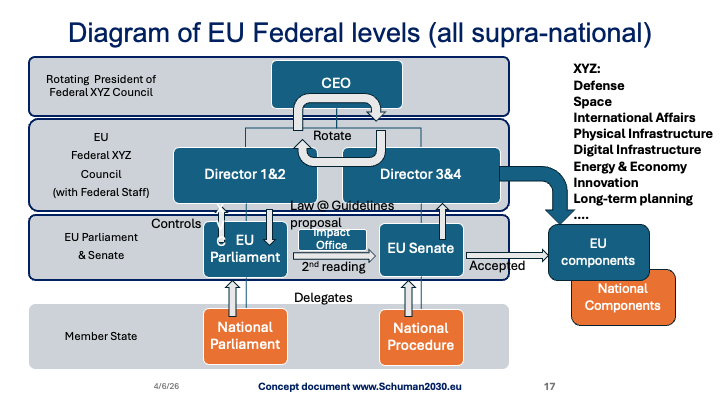
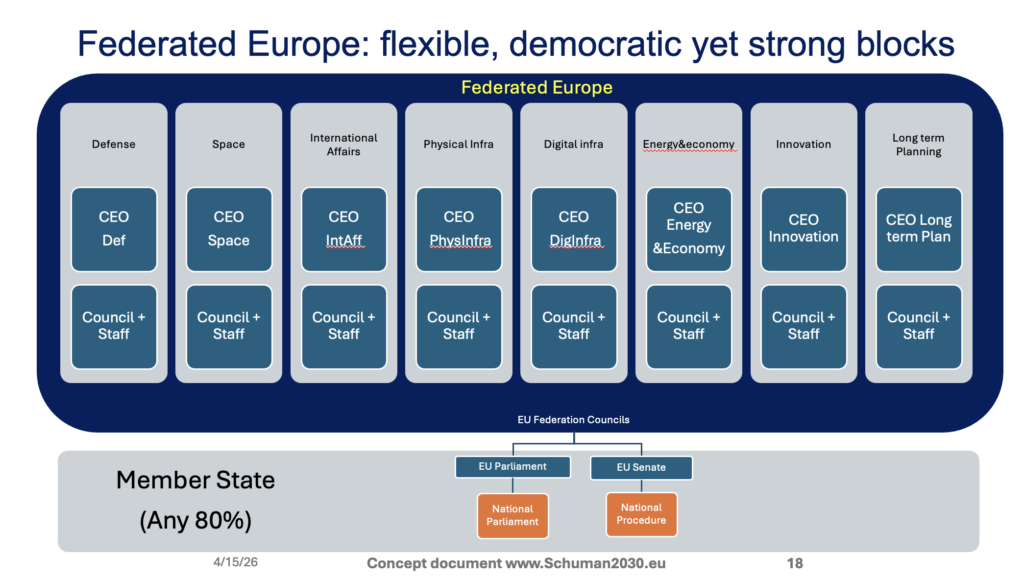
While above still are the original aims, in WP6a we present a first concept for a new Bounded Federal Europe with the creation of a European Federal Council for each supra-national competence domain like Defense, Internation Affars, Energy&Economy, and 5 more domains. Each Federal Council is managed by 4 Directors on a rotating role. The whole of all European Counsils forms the new Federated Europe, represented by its Chairman. Democratic control is exercised by the European Citizens Parliament, a Senate of statesmen and experts as well as an Impact Office. At the start an subsidiarity audit clearly seperates competences between national and supra-national levels. As a general rule, we adopt the principle that any decision need an 80% concensus. See more details in WP6a.

Posted in Uncategorized | Leave a comment

Decentralisation benefits

A key question is, what makes a socio-political system more efficient than others? As one can read in WP1, the difference between two similar countries (Switzerland and Belgium) can be significant. The comparison can be made using several metrics but in the end it’s always the output level that counts, for example the GDP per capita. In this case Switzerland performs 20 to 30% better than Belgium (section 5.6 in WP1) Hence, the country produces more wealth. More wealth that can be used to improve the life and environment for all. Think about better roads, public transport, culture, innovation, etc. A lesser performance also translates in lesser performance in other metrics like unemployment rate, public debt and inflation. Hence, the wealth is also less well spend, not on innovation and quality of life but on non-productive expenditures. The latter starts a vicious cycle as the growing budget deficits shows in Belgium.

To illustrate and analyse this further, we look at the performance in education. While not listed in WP1, Belgium spends 6,6% of its GDP on education while Switzerland 5,6% but in nominal terms the figures per capita are €3386 and €5280 respectively which means 56% more for Switzerland. Swiss students consistently outperform their Belgian counterparts in mathematics. While Belgium’s science scores have declined by 11 points since 2015, Swiss performance in science has remained remarkably stable.

This situation is well known in Belgium and its not only related to the expenditures. For example, from 2014 to 2024, the total education workforce in Flanders (teachers and administrators) grew by nearly 13% to 14% over a single decade while the number of pupils only rose by 7%. Despite having more staff per student than 50 years ago, educational outcomes (PISA scores) in both Flanders and Wallonia have reached historical lows in 2025. 

A deeper analysis points to a structural cause. In 1975 (Flanders) and 1978 (French Community) a “Reformed Secondary Education” (RSE) was introduced to replace traditional rigid tracks with a more flexible, comprehensive system aimed at increasing “social equality”. This had multiple effects that reduced the efficiency. Both regions centralised education away from the schools and teachers and imposed rather inflexible teaching programs while burdering them with many more administrative tasks. In the Flemish Community (2024–2025 school year), the workforce has grown to approximately 179,205 full-time equivalents (FTE) with 13,243 FTE or 7,4% strictly dedicated to non-teaching positions such as principals, inspectors, student counselors, and Centre for Educational Guidance (CLB) staff. Worse is that teaching staff is burdened with what teachers call “excessive administrative work”.  One result is that many leave the profession and there is a shortage of staff. If only a quarter of the administrative staff would return to teaching, the gaps would be filled.

This highlights the structural differences between the bottom-up and decentralised subsidiarity in Switzerland and the top-down centralised subsidiarity in Belgium. In a decentralised system the responsibility is mostly with the citizens away from central planners dictating every detail. It is motivating to be responsible and being able to apply one’s education and skills for the best as one sees fit. While not everyone is perfect and makes mistakes, the correction loop is short. A teacher knows his class and a school knows his teachers. The central ministry has to rely on reports. By imposing how and what teachers should do, a mistake was made that only becomes visible years later in e.g. international scores. The cost of excessive administration has wide-spreading effects not only by taking away resources from teaching, but also by demotivating teachers and producing less educated students. The goal of achieving of “social equality”  by imposing equal teaching was a failure that affected everyone. And while some reforms are now underway to correct this view, it took 50 years and affected a whole generation. This also contributed to the lower economical performance we mentioned at the beginning of this post. A well performing country is the work of qualified people, whether they work in the public or private sector.


Posted in Uncategorized | Leave a comment

Paradoxes of Democracy

Jack Birner, professor emeritus at University of Trento, Department of Sociology and Social Research, gave a talk for the Workshop “Democracy in the real world, Epistemic challenges and behavioural insights, Pisa, 20 November 2025. The discussion of Popper’s four paradoxes related to democracy leads to a distinction between two models or types of democracy, i.e.  Deliberative Democracy and Critical Democracy. These correspond more or less with what we call  Representative or Conflict Democracy and Consensus Democracy.

Hereby a list of the paradoxes: 

P1: The paradox of democracy (this is the risk of the dictatorship of the majority discussed in WP1).
P2: The paradox of freedom
P3: The paradox of sovereignty
P4: The paradox of tolerance
P5: The paradox of representation
P6: The paradox of the popularity of DD (Deliberative Democracy, aka participatory democracy)
P7: The paradox of information
P8: The paradox of truthfulness
P9: The paradox of time, or of the time horizon
P10: The paradox of the success of democracy
P11: The paradox of the attractiveness of democracy
P12: The paradox of populism.

In his talk he starts from Plato, Popper and Hayek. A few extracts to think about

Popper proposes to replace Plato’s question of who should rule by the question: “How can we so organize political institutions that bad or incompetent rulers can be prevented from doing too much damage?”

“Prepare for the worst, aim for the best. We may call this Popper’s maximin rule. And in fact, a guiding principle of his social and political philosophy is the idea that instead of the state having the task of maximizing the happiness of its citizens, it should limit itself to reducing their suffering. John Watkins has coined the label of negative utilitarianism for this.”

It seems to us that the Swiss democratic system has foud a way to implement this in reality by having a system that must provide for all citizens and obtain their approval. This avoid the conflicts whereby the winner takes all and mainly looks for the special interest of who has elected them.

Source: https://www.academia.edu/145145144/Some_paradoxes_of_democracy

Also have a look at the other work of Jack Birner.

Some_paradoxes_of_democracy

Posted in Uncategorized | Leave a comment

WP1 – on Switzerland

Hereby the first release (V.1.5) of the Working Paper 1 on direct democracy in Switzerland, including a comparison with Belgium, which is a country of similar size but with a representative democracy system.

0. Democracy and political parties in SwitzerlandV_1-5_EN

Hierbij de eerste versie (V.1.5) van het werkdocument 1 over de directe democratie in Zwitserland, inclusief een vergelijking met België, een land van vergelijkbare omvang maar met een representatieve democratie.

De oorspronkelijke tekst is in het Engels geschreven; de lezer kan ook een Nederlandse versie downloaden.

0. Democracy and political parties in SwitzerlandV_1-5_NL

Voici la première version (V.1.5) du Document de travail n° 1 sur la démocratie directe en Suisse, incluant une comparaison avec la Belgique, pays de taille similaire doté d’un système de démocratie représentative.

Le texte original est en anglais ; une version en français est également disponible en téléchargement. Cette version n’est pas encore corrigée (grammaire).

0. Democracy and political parties in SwitzerlandV_1-5_FR

Hiermit erscheint die erste Version (V.1.5) des Arbeitspapiers 1 zur direkten Demokratie in der Schweiz, inklusive eines Vergleichs mit Belgien, einem Land ähnlicher Größe mit einem repräsentativen Demokratiemodell.

Der Originaltext ist auf Englisch verfasst; eine deutsche Version steht ebenfalls zum Download bereit. Diese Version wurde noch nicht auf Grammatikfehler geprüft.

0. Democracy and political parties in SwitzerlandV_1-5_DE

Posted in Uncategorized | Leave a comment

Policy Brief

This document is a short Policy Brief on the Schuman2030 project’s goals and vision. Following Working Papers will consist of specfic topics and analyse them in more depth.

The policy covers following topics:

  1. A short introduction on “The EU’s Democratic Evolution”
  2. Summary for Policymakers: Subsidiarity & Direct Democracy Protocol”
  3. Subsidiarity: a bottom-up competence model.
  4. Strengthening Subsidiarity — A Tiered Competence Model for Bottom-Up Democracy
  5. Competence Allocation. A Bottom-Up Subsidiarity-Based EU
  6. EU Long-Term Strategic Framework

PolicyBrief_Schuman2030_V-1-0

Posted in Uncategorized | Leave a comment