
Hereby the first DRAFT release (V.1.1) of the Working Paper 6 on the proposed reform of the EU. This is a pre-release under then form of a presentation. Readers are invited to forward theor constructive feedback.
English version:
PostLisbonReform_presentation-v8
Post_Lisbon_proposal_Schuman2030_WP6a_V1_EN
Dutch (Nederlands) versie:
Post_Lisbon_proposal_Schuman2030_WP6a_V1_NL
Version en Français:
Post_Lisbon_proposal_Schuman2030_WP6a_V1_FR
Deutsche Version:
Post_Lisbon_proposal_Schuman2030_WP6a_V1_DE
Summary:
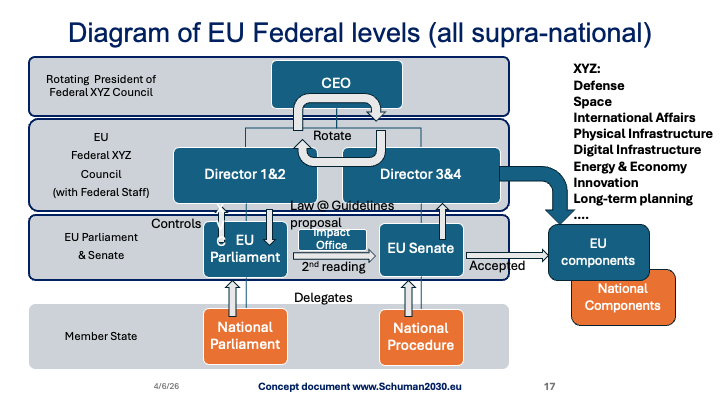
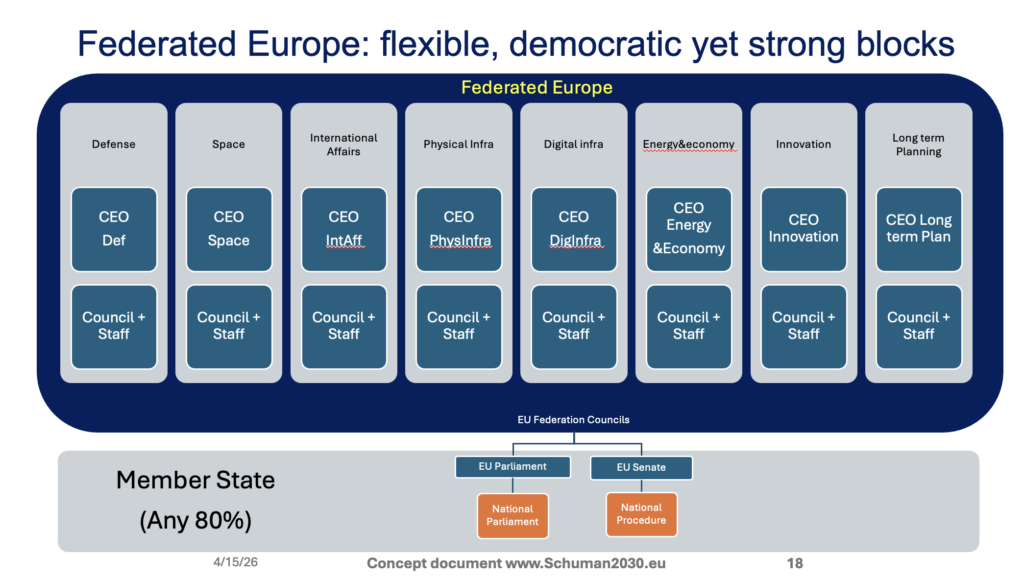
The Schuman2030 initiative proposes a fundamental restructuring of the European Union, arguing that the post-Lisbon framework suffers from a dual failure: regulatory overreach in domains better left to Member States, and structural weakness in genuinely supra-national domains such as defence, diplomacy, and strategic infrastructure. Drawing inspiration from Swiss consensus democracy and Singaporean meritocratic governance, the proposal envisions a bounded federal architecture, strong where Europe must act as one, absent where it need not. Core institutional innovations include a Citizens’ Parliament freed from transnational political blocs, a Senate of experienced statesmen and experts serving as a subsidiarity guardian, an independent Impact Office producing neutral legislative assessments, and domain-specific Federal Councils with operational autonomy and rotating leadership. The transition is designed to be politically viable: existing heads of state are converted from potential blockers into founding members of the new Senate, and the process is launched via Enhanced Cooperation (Article 20 TEU) with as few as six Member States, starting with defence. A comprehensive subsidiarity audit would return over-regulated competences to the national level while consolidating federal authority in eight strategic domains.
Note that the proposal is yet at the stage of a concept. The Schuman2030 proposal in its concept stage is strongest on the new things it wants to build (Federal Councils, Senate, Impact Office, defence and other Federal Council integration) and weakest on the existing things it needs to analyse (single market, euro, rule of law, migration, climate, trade, social policy). These are the daily substance of EU governance, affecting hundreds of millions of citizens directly and what works well should be kept and improved.
Samenvatting:
Het Schuman2030 initiatief stelt een fundamentele herstructurering van de Europese Unie voor, met het argument dat het post–Lissabon–kader een dubbele tekortkoming kent: regelgevende overschrijding in domeinen die beter aan lidstaten worden overgelaten, en structurele zwakte in echt supranationale domeinen zoals defensie, diplomatie en strategische infrastructuur. Geïnspireerd door Zwitserse consensusdemocratie en Singaporese meritocratische governance, voorziet het voorstel een begrensde federale architectuur, sterk waar Europa als één moet optreden, afwezig waar dat niet nodig is. Kerninnovaties van institutionele instellingen zijn onder meer een Citizens‘ Parliament vrij van transnationale politieke blokken, een Senaat van ervaren staatslieden en experts die als subsidiariteitshoeder fungeert, een onafhankelijk Impact Office dat neutrale wetgevende beoordelingen opstelt, en domeinspecifieke Federale Raden met operationele autonomie en roterend leiderschap. De overgang is politiek haalbaar gemaakt: bestaande staatshoofden worden omgevormd van potentiële tegenstanders tot oprichters van de nieuwe Senaat, en het proces wordt gestart via Versterkte Samenwerking (Artikel 20 TEU) met slechts zes lidstaten, te beginnen met defensie. Een uitgebreide subsidiariteitsaudit zou overgereguleerde bevoegdheden terugbrengen naar het nationale niveau en de federale autoriteit consolideren in acht strategische domeinen.
Let op dat het voorstel zich nog in het stadium van een concept bevindt. Het Schuman2030–voorstel in zijn conceptfase is het sterkst op de nieuwe zaken die het wil bouwen (Federale Raden, Senaat, Impact Office, defensie en andere Federale Raden) en het zwakst op de bestaande zaken die het moet analyseren (interne markt, euro, rechtsstaat, migratie, klimaat, handel, sociaal beleid). Dit is wat er vandaag in Europa direct honderden miljoenen burgers raakt en wat goed werkt moet behouden en verbeterd worden.
The Schuman2030 initiative deserves real praise for its bold and creative plan to change Europe based on the idea that it should be “strong where one Europe is needed, modest where national autonomy should prevail.” It offers a new, well-thought-out way of thinking that could change the way Europe works together without hurting the unique identities of its member states. The idea of a Citizens’ Parliament that isn’t tied to party blocs and a Senate of statesmen that protects subsidiarity shows a deep understanding of what Brussels often lacks: trust, expertise, and closeness to democracy.
Still, this good momentum needs to be handled with care. The difficulty of moving from the Lisbon framework to a limited federal structure should not be downplayed. There is a genuine risk that institutional innovation may become hindered by procedural inertia, national distrust, or excessive technocratic oversight that depletes democratic vitality. Also, the focus on new structures like the Federal Councils and the Impact Office might make people forget how important it is to strengthen the existing pillars—the single market, the eurozone, and the rule of law—that directly affect the lives of hundreds of millions of Europeans.
That is exactly why Schuman2030 is strong right now: it is in the concept phase, which gives people a chance to get involved and give honest feedback before any changes are made to the structure. If this project can connect idealism with practical action, it could bring back trust and direction to the European project.