Summary
Europe at 76:
The Dream, The Achievement, The Drift
A commemorative short essay for May 9, 2026, 76 years after Schuman’s declaration.
“World peace cannot be safeguarded without the making of creative efforts proportionate to the dangers which threaten it.”, Robert Schuman, May 9, 1950
A Voice from the Ruins
Seventy-six years ago, French Foreign Minister Robert Schuman stood at the Quai d’Orsay and proposed the unthinkable: merging French and German coal and steel — the sinews of war — under a common supranational authority. Just five years after a war that killed sixty million, a French minister was binding his nation’s industrial heart to its historic enemy.
But this was no mere trade deal. Schuman’s declaration stated it explicitly: pooling coal and steel was “a first step in the federation of Europe“, a federation he called “indispensable to the preservation of peace.” The seed was industrial. The tree was to be political.
What Was Achieved
The achievements are extraordinary, so extraordinary that they’ve become invisible.
Peace. For five centuries, major European wars erupted roughly every generation. Since 1950, not a single shot has been fired between member states. War between France and Germany is not merely unlikely — it is unthinkable. This alone may be the greatest political achievement of the modern era.
Prosperity. The Single Market — 450 million consumers, €17 trillion in GDP — is the world’s largest integrated economic area. Free movement of goods, capital, services, and people transformed a fragmented continent into an economic powerhouse. A Portuguese engineer works in Munich. A Polish student studies in Paris. A Dutch retiree lives in Spain.
Identity. Erasmus sent 12 million students across borders. Schengen abolished passport controls. The euro became the world’s second reserve currency. For younger Europeans, a fragmented Europe is as unimaginable as war between neighbours.
Influence. The “Brussels Effect” turned EU regulations into global standards — from GDPR to product safety to emissions rules. Europe may lack tech giants and aircraft carriers, but when Brussels sets a standard, the world follows.
Where It Went Wrong
Yet beneath these achievements lies a deepening structural crisis.
The destination was abandoned. Schuman proposed a first step toward federation. Seventy-six years later, the word “federation” is taboo in European politics. Leaders speak of “ever closer union”, a phrase so vague it means everything and nothing. Europe is trapped in permanent adolescence: no longer the infant of the coal and steel community, but never the adult federation the founders envisioned.
Democracy was never built in. The Monnet method, integration through technocratic institutions, was brilliant for the 1950s. But as Europe accumulated power, it never accumulated democratic legitimacy. The Commission proposes laws but isn’t elected. The Council decides behind closed doors. When French and Dutch voters rejected the Constitutional Treaty in 2005, elites repackaged it as the Lisbon Treaty and bypassed referendums. Brexit was partly the bill for decades of democratic deficit.
Regulation replaced strategy. Schuman proposed focused authority in a specific domain. Europe built diffuse authority across 100,000 pages of legislation, regulating vacuum cleaner wattage while failing to coordinate defence. The 2024 Draghi Report delivered a devastating verdict: Europe’s productivity gap with the US has widened for two decades, energy costs are 2-3 times higher, and not one of the world’s top 50 tech companies is European. Europe needs €800 billion in additional annual investment just to stay competitive.
Unanimity became paralysis. In foreign policy, defence, and taxation, every member state holds a veto. Hungary blocks sanctions on Russia. Any single country can hold twenty-six others hostage. Europe spends €200 billion annually on defence but operates 27 separate armies with 17 types of main battle tank. It can regulate your toaster but cannot agree on a common defence while Russia wages war on its borders.
Subsidiarity was inverted. Europe regulates what should be local (product specifications, professional qualifications) and fragments what should be federal (defence, energy, foreign policy). The precise opposite of effective governance — and the precise opposite of what Schuman envisioned.
The World of 2026
The geopolitical landscape makes reform existential, not optional.
Russia wages war on Europe’s eastern border. The United States, running massive deficits and turning inward, no longer offers unconditional security guarantees. China dominates global manufacturing and expands influence across Africa and Asia. And the February 2026 US-Israeli strikes on Iran triggered Europe’s second energy crisis in four years, fuel costs up 25-30%, a brutal reminder that energy dependence is a strategic vulnerability.
Europe faces federal-scale problems with confederal-scale institutions. It has the GDP of a superpower, the military coordination of a debating society, and the strategic autonomy of a dependent.
Complete the Cathedral
Schuman’s declaration contains a phrase usually quoted to justify inaction: “Europe will not be made all at once, or according to a single plan. It will be built through concrete achievements.” But read it again. The emphasis is on achievement, not on patience. Schuman was counselling action — bold, structural, institutional action.
Seventy-six years of first steps without arriving would strike him not as prudence, but as a failure of political will.
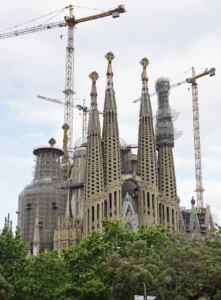
The cathedral Schuman began is magnificent in its partial construction. But an unfinished cathedral cannot shelter anyone from the storm. The dangers today are proportionate to those of 1950. The question is whether the creative efforts will be.
Full texts:Europe at 76_Schuman’s_legacy_EN (English)
Europa op 76_NL (Nederlands)
Europa op 76_FR (Français)
Europa mit 76_DE (Deutsch)