Schuman’s declaration 76 years ago 9th May

Summary

Europe at 76:

The Dream, The Achievement, The Drift

A commemorative short essay for May 9, 2026, 76 years after Schuman’s declaration.

“World peace cannot be safeguarded without the making of creative efforts proportionate to the dangers which threaten it.”, Robert Schuman, May 9, 1950

A Voice from the Ruins

Seventy-six years ago, French Foreign Minister Robert Schuman stood at the Quai d’Orsay and proposed the unthinkable: merging French and German coal and steel — the sinews of war — under a common supranational authority. Just five years after a war that killed sixty million, a French minister was binding his nation’s industrial heart to its historic enemy.

But this was no mere trade deal. Schuman’s declaration stated it explicitly: pooling coal and steel was a first step in the federation of Europe, a federation he called indispensable to the preservation of peace.” The seed was industrial. The tree was to be political.

What Was Achieved

The achievements are extraordinary, so extraordinary that they’ve become invisible.

Peace. For five centuries, major European wars erupted roughly every generation. Since 1950, not a single shot has been fired between member states. War between France and Germany is not merely unlikely — it is unthinkable. This alone may be the greatest political achievement of the modern era.

Prosperity. The Single Market — 450 million consumers, €17 trillion in GDP — is the world’s largest integrated economic area. Free movement of goods, capital, services, and people transformed a fragmented continent into an economic powerhouse. A Portuguese engineer works in Munich. A Polish student studies in Paris. A Dutch retiree lives in Spain.

Identity. Erasmus sent 12 million students across borders. Schengen abolished passport controls. The euro became the world’s second reserve currency. For younger Europeans, a fragmented Europe is as unimaginable as war between neighbours.

Influence. The “Brussels Effect” turned EU regulations into global standards — from GDPR to product safety to emissions rules. Europe may lack tech giants and aircraft carriers, but when Brussels sets a standard, the world follows.

Where It Went Wrong

Yet beneath these achievements lies a deepening structural crisis.

The destination was abandoned. Schuman proposed a first step toward federation. Seventy-six years later, the word “federation” is taboo in European politics. Leaders speak of “ever closer union”, a phrase so vague it means everything and nothing. Europe is trapped in permanent adolescence: no longer the infant of the coal and steel community, but never the adult federation the founders envisioned.

Democracy was never built in. The Monnet method, integration through technocratic institutions, was brilliant for the 1950s. But as Europe accumulated power, it never accumulated democratic legitimacy. The Commission proposes laws but isn’t elected. The Council decides behind closed doors. When French and Dutch voters rejected the Constitutional Treaty in 2005, elites repackaged it as the Lisbon Treaty and bypassed referendums. Brexit was partly the bill for decades of democratic deficit.

Regulation replaced strategy. Schuman proposed focused authority in a specific domain. Europe built diffuse authority across 100,000 pages of legislation, regulating vacuum cleaner wattage while failing to coordinate defence. The 2024 Draghi Report delivered a devastating verdict: Europe’s productivity gap with the US has widened for two decades, energy costs are 2-3 times higher, and not one of the world’s top 50 tech companies is European. Europe needs €800 billion in additional annual investment just to stay competitive.

Unanimity became paralysis. In foreign policy, defence, and taxation, every member state holds a veto. Hungary blocks sanctions on Russia. Any single country can hold twenty-six others hostage. Europe spends €200 billion annually on defence but operates 27 separate armies with 17 types of main battle tank. It can regulate your toaster but cannot agree on a common defence while Russia wages war on its borders.

Subsidiarity was inverted. Europe regulates what should be local (product specifications, professional qualifications) and fragments what should be federal (defence, energy, foreign policy). The precise opposite of effective governance — and the precise opposite of what Schuman envisioned.

The World of 2026

The geopolitical landscape makes reform existential, not optional.

Russia wages war on Europe’s eastern border. The United States, running massive deficits and turning inward, no longer offers unconditional security guarantees. China dominates global manufacturing and expands influence across Africa and Asia. And the February 2026 US-Israeli strikes on Iran triggered Europe’s second energy crisis in four years, fuel costs up 25-30%, a brutal reminder that energy dependence is a strategic vulnerability.

Europe faces federal-scale problems with confederal-scale institutions. It has the GDP of a superpower, the military coordination of a debating society, and the strategic autonomy of a dependent.

Complete the Cathedral

Schuman’s declaration contains a phrase usually quoted to justify inaction: “Europe will not be made all at once, or according to a single plan. It will be built through concrete achievements.” But read it again. The emphasis is on achievement, not on patience. Schuman was counselling action — bold, structural, institutional action.

Seventy-six years of first steps without arriving would strike him not as prudence, but as a failure of political will.

The cathedral Schuman began is magnificent in its partial construction. But an unfinished cathedral cannot shelter anyone from the storm. The dangers today are proportionate to those of 1950. The question is whether the creative efforts will be.

Full texts:Europe at 76_Schuman’s_legacy_EN (English)

Europa op 76_NL  (Nederlands)

Europa op 76_FR  (Français)

Europa mit 76_DE (Deutsch)

Posted in Uncategorized | Leave a comment

WP6 PostLisbon Reform Concept

Hereby the first DRAFT release (V.1.1) of the Working Paper 6 on the proposed reform of the EU.  This is a pre-release under then form of a presentation. Readers are invited to forward theor constructive feedback.


English version:

PostLisbonReform_presentation-v8

Post_Lisbon_proposal_Schuman2030_WP6a_V1_EN

Dutch (Nederlands) versie:

Post_Lisbon_proposal_Schuman2030_WP6a_V1_NL

Version en Français:

Post_Lisbon_proposal_Schuman2030_WP6a_V1_FR

Deutsche Version:

Post_Lisbon_proposal_Schuman2030_WP6a_V1_DE

Summary:

The Schuman2030 initiative proposes a fundamental restructuring of the European Union, arguing that the post-Lisbon framework suffers from a dual failure: regulatory overreach in domains better left to Member States, and structural weakness in genuinely supra-national domains such as defence, diplomacy, and strategic infrastructure. Drawing inspiration from Swiss consensus democracy and Singaporean meritocratic governance, the proposal envisions a bounded federal architecture, strong where Europe must act as one, absent where it need not. Core institutional innovations include a Citizens’ Parliament freed from transnational political blocs, a Senate of experienced statesmen and experts serving as a subsidiarity guardian, an independent Impact Office producing neutral legislative assessments, and domain-specific Federal Councils with operational autonomy and rotating leadership. The transition is designed to be politically viable: existing heads of state are converted from potential blockers into founding members of the new Senate, and the process is launched via Enhanced Cooperation (Article 20 TEU) with as few as six Member States, starting with defence. A comprehensive subsidiarity audit would return over-regulated competences to the national level while consolidating federal authority in eight strategic domains.

Note that the proposal is yet at the stage of a concept. The Schuman2030 proposal in its concept stage is strongest on the new things it wants to build (Federal Councils, Senate, Impact Office, defence and other Federal Council integration) and weakest on the existing things it needs to analyse (single market, euro, rule of law, migration, climate, trade, social policy). These are the daily substance of EU governance, affecting hundreds of millions of citizens directly and what works well should be kept and improved.

Samenvatting:

Het Schuman2030 initiatief stelt een fundamentele herstructurering van de Europese Unie voor, met het argument dat het postLissabonkader een dubbele tekortkoming kent: regelgevende overschrijding in domeinen die beter aan lidstaten worden overgelaten, en structurele zwakte in echt supranationale domeinen zoals defensie, diplomatie en strategische infrastructuur. Geïnspireerd door Zwitserse consensusdemocratie en Singaporese meritocratische governance, voorziet het voorstel een begrensde federale architectuur, sterk waar Europa als één moet optreden, afwezig waar dat niet nodig is. Kerninnovaties van institutionele instellingen zijn onder meer een Citizens Parliament vrij van transnationale politieke blokken, een Senaat van ervaren staatslieden en experts die als subsidiariteitshoeder fungeert, een onafhankelijk Impact Office dat neutrale wetgevende beoordelingen opstelt, en domeinspecifieke Federale Raden met operationele autonomie en roterend leiderschap. De overgang is politiek haalbaar gemaakt: bestaande staatshoofden worden omgevormd van potentiële tegenstanders tot oprichters van de nieuwe Senaat, en het proces wordt gestart via Versterkte Samenwerking (Artikel 20 TEU) met slechts zes lidstaten, te beginnen met defensie. Een uitgebreide subsidiariteitsaudit zou overgereguleerde bevoegdheden terugbrengen naar het nationale niveau en de federale autoriteit consolideren in acht strategische domeinen.

Let op dat het voorstel zich nog in het stadium van een concept bevindt. Het Schuman2030voorstel in zijn conceptfase is het sterkst op de nieuwe zaken die het wil bouwen (Federale Raden, Senaat, Impact Office, defensie en andere Federale Raden) en het zwakst op de bestaande zaken die het moet analyseren (interne markt, euro, rechtsstaat, migratie, klimaat, handel, sociaal beleid). Dit is wat er vandaag in Europa direct honderden miljoenen burgers raakt en wat goed werkt moet behouden en verbeterd worden.

Posted in Uncategorized | 1 Comment

What is this all about?

Welcome to the website of the Schuman2030 project.

Our objective is simple, yet ambitious and necessary.

Europe today needs to make a step forward, and when we say Europe we really mean the European Union (the EU). The EU has been built in slow steps by way of treaties since the end of the second World War. The goals were to strengthen the European identity by first creating tighter economic links and today even more political links.

Robert Schuman (1886–1963) was a French statesman and one of the principal architects of European integration after World War II. His most significant contribution was the Schuman Declaration of May 9, 1950, in which he proposed placing French and German coal and steel production under a common High Authority — open to other European countries. This initiative aimed to make war between historic rivals France and Germany “not merely unthinkable, but materially impossible.”

This proposal directly led to the creation of the European Coal and Steel Community (ECSC) via the Treaty of Paris (1951) — the first step toward today’s European Union.

Schuman is often called the “father of Europe” for his vision of supranational cooperation as a path to peace and prosperity. It should be noted that the aim was cooperation, not creating a supranational authority.

After the Treaty of Lisbon, the EU needs to take a new step. In honor of Robert Schuman, we called it the Schuman2030 project.

Today, we must admit that the de jure situation is quite different from the de facto situation. There is a lack of democracy with citizens’ participation and there is an overreach by the EU Commission. An overreach that translates itself in EU Directives often covering micro-level issues and complex bureaucratic regulations. 80% of the member states’ laws are an implementation of these directives. We need to reduce these bureaucratic regulations as they strangle Europe’s economic fabric. Competences need to go back to the member states and the local level.

At the same time, it is clear that the EU is increasingly confronted with world-wide challenges: geo-political, economic, pandemics and recently war at our borders whereby Europe is squeezed between superpowers. The EU is here largely operating without a clear legal base and without democratic control. At the same time, we must acknowledge that there is a lack of a long term vision.

Project Schuman2030 aims a follow-up treaty of Lisbon addressing the challenges. We look outside and get our inspiration from successful practices elsewhere.

1. Bottom-up subsidiarity of competences

Inspired by the direct democracy framework of Switzerland, competences are delegated to their most appropriate level, following the rule:
Decisions at lowest level possible unless EU-wide action is necessary.

2. Increased participation of citizens and the European Parliament in the decisions. Citizen’s Initiatives and binding referenda for important matters.

3. Reinforcing the supra-national and cross border competences

On the world-wide scene the EU must be able to act as a strong and resilient block and have the infrastructure as well as command structure to enable this.

4. Long term planning and supervision

In a world that is changing fast and technology is disrupting economic immobility, Europe must look decades ahead not driven by ideology or political opportunism but by a solid insight in what the future can bring and how to anticipate it.

Note:

The EU and its treaties are now a complex, rigid and bureaucratic matter. The proposed changes will greatly simplify the framework and reintroduce the flexibility that each member state needs to fully develop. At the same, the EU leadership will be able to focus on these issues that concern all member states and for which the EU brings a bonus. Keep following project Schuman2030. This is Work In Progress.

Posted in Uncategorized | Leave a comment

The EU banana interview

From a banana regulation to a new vision for Europe.

Question. Is there an EU regulation on the size and form of bananas?
Answer:
Yes, there is indeed an EU regulation concerning the size and form of bananas, though it is often the subject of significant exaggeration and “Euro-myths.” The current rules are primarily found in Commission Implementing Regulation (EU) No 1333/2011, which updated and replaced the original (and more famous) 1994 regulation.
However, there is a gap between the myth and the reality.

The rest of the interview is worth reading, and no it’s not only about bananas. It’s brings us back to the roots of the EU, i.e. the Schuman declaration of 1950 and how it enables a new vision for Europe.

The EU banana interview_EN

Vertaald naar het Nederlands:

The EU banana interview_NL


Posted in Uncategorized | Leave a comment

Why Schuman2030 reform is urgent

Europe Squeezed: Why Schuman2030 Reform Is Urgent

By Eric Verhulst, www.Schuman2030.eu

Europe is caught between superpowers — and running out of time. Following WWII, the Marshall Plan created economic dependence on the United States, while NATO embedded European defence within a US-led security architecture. During the Cold War, this arrangement worked. American security guarantees allowed European nations to build generous social democracies. But those days are over.

The USA, running massive budget deficits and losing economic ground to China, is looking inward. China, meanwhile, expands influence through economic prowess, dominating Africa and Southeast Asia through Belt and Road infrastructure investments, though many of these projects are now being renegotiated, backed increasingly by military power projection in the South China Sea. In the Middle East, endless conflicts fueled by radical regimes keep the region unstable.

Europe’s Energy Achilles Heel

Russia’s 2022 invasion of Ukraine brutally exposed Europe’s dangerous energy dependency. Years of cheap Russian gas and oil financed Putin’s war machine while constraining European policy options. Since then, the EU has reduced Russian gas imports from 45% to approximately 12%, with Russian pipeline exports to Europe falling 44% in 2025 alone to their lowest since the mid-1970s. But this decoupling came at enormous cost. The EU spent over €800 billion on energy crisis mitigation between 2022 and 2024, and the transition to alternative suppliers required massive new LNG infrastructure (shale gas from the US) and drove industrial energy costs sharply higher.

Then came the second shock. On 28 February 2026, US-Israeli strikes on Iran, nearly 900 sorties in 12 hours, triggered a new energy crisis for Europe. Oil prices spiked roughly 8% and European gas prices surged around 20% in the first week, with continued volatility since. Global commodity markets remain in turmoil. Europe’s energy and raw materials vulnerability is no longer just an economic problem, it is a unexpected security threat.

The strikes have also reshuffled the geopolitical deck. Iran’s oil exports, a key source of discounted crude for China, have been severely disrupted. Russia’s strategic position has been weakened by the loss of its Iranian partner. But these shifts offer Europe no comfort without the institutional capacity to act on them.

Institutional Fragmentation: Europe’s Core Problem

These geopolitical vulnerabilities are amplified by Europe’s institutional fragmentation. The EU lacks unified command in defence (amongst others). Despite pledges, only 23 of 32 NATO allies met the 2% GDP defence spending target in 2025. Europe speaks with 27 voices in foreign policy and is paralysed by unanimity requirements on critical decisions. As the 2024 Draghi Report on EU competitiveness made painfully clear, Europe suffers from a widening productivity gap and chronic underinvestment compared to the US and China. Meanwhile, regulatory overreach and heavy taxation further undermine economic competitiveness.

To compete with the strategic coherence of the USA and China, Europe needs structural reform, not more incremental tinkering.

Where to Look for Inspiration

Schuman2030 advocates the reform Europe desperately needs. And the inspiration is all around us.

The USA remains the world leader in entrepreneurship and innovation. All major tech companies are there, backed by abundant investment capital and a culture that rewards risk-taking. China leads in manufacturing and increasingly in innovation, executing a long-term strategy with meritocratic leadership recruited for competence, not popularity. Singapore demonstrates that small states can punch far above their weight through rigorous governance and institutional excellence. And Switzerland, a diverse mini-Europe of four languages and 26 cantons, thrives on consensus democracy, bottom-up subsidiarity, and the “magic formula” that ensures broad coalition governance rather than winner-take-all conflict.

Five Goals for a Reformed Europe

Europe must achieve five structural goals:

  1. Critical mass through Schuman2030’s bounded multi-federal structure, assembling resources in strategic domains, such as defence, space, international affairs, energy, infrastructure, under an exclusive command.
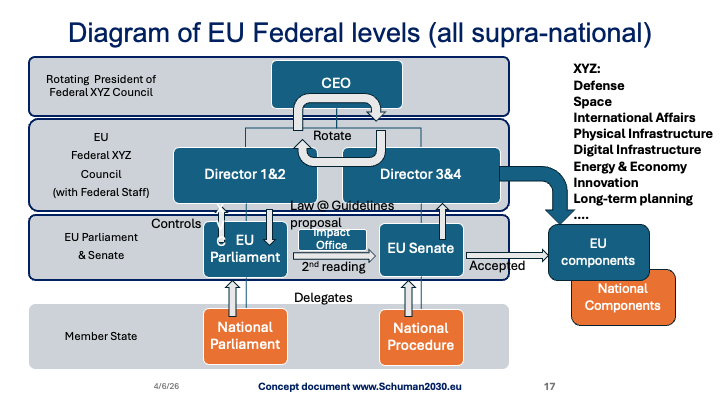
  2. Competence through domain specific Federal Councils led by experienced statesmen and technical experts, scrutinised by a Citizens’ Parliament composed of each nation’s best delegates. A wise Senate providing a second reading and deeper analysis.
  3. Efficiency by drastically reducing the regulatory burden through a subsidiarity audit, returning over-regulated competences to Member States where they belong, while maintaining strong rules where cross-border coordination is essential.
  4. Speed through the 80% majority rule, a threshold high enough to force genuine consensus instead of coercion by a narrow majority, but low enough to prevent a blocking minority. This replaces both the current qualified majority (55% of states representing 65% of population) and the unanimity rule that gives any single state a veto. Combined with AI-driven digitalisation, this can cut bureaucratic red tape dramatically.
  5. Long-term strategy as a permanent competence domain, insulated from short-term political opportunism, ensuring that Europe can plan on 10- and 20-year horizons the way China and Singapore routinely do.

Meritocracy Meets Democracy

The political philosopher Tongdong Bai (Dongfang Chair Professor of Philosophy at Fudan University, Global Professor of Law at NYU’s Law School) offers an inspiring lens on these questions*. He argues that Western democracy’s current crisis stems from conflating liberalism (socialism in Europe) with democracy, and that an unchecked majority rule not necessarily representing all citizens, can threaten the rule of law and the protection of liberties. His Confucian-inspired solution: a mixed regime combining democratic accountability through an elected lower house with meritocratic wisdom through an upper house selected by examination and proven governance record.

Schuman2030 independently reached similar wisdom without copying any single model. The Senate of proven statesmen provides meritocratic checks on populism. The Impact Office offers expert analysis to counter anti-intellectualism and short-termism. The 80% threshold prevents tyranny of bare majorities. But unlike pure meritocracy, Schuman2030 maintains strong democratic accountability through the Citizens’ Parliament and binding referendums, learning from both Swiss consensus democracy and Asian meritocratic governance.

The Choice Before Us

We don’t need to copy others. We need to be inspired by what works.

If Europe combines American entrepreneurship, Chinese strategic thinking, Swiss consensus-building, and Singapore’s meritocratic competence, while preserving European values of liberty, subsidiarity, and democratic accountability, the future can look bright again.

The alternative is continued decline, squeezed between superpowers who act while Europe deliberates.

*: See https://schuman2030.eu/confucius-meets-democracy/

Nederlandse versie:

Europa in nauwe schoentjes: waarom de hervorming van Schuman2030 dringend nodig is

Eric Verhulst, www.Schuman2030.eu

Europa zit tegenwoordig geklemd tussen supermachten. Na de Tweede Wereldoorlog creëerde het Marshallplan een economische afhankelijkheid van de Verenigde Staten, terwijl de NAVO de Europese defensie verankerde in een door de VS geleide veiligheidsstructuur. Deze regeling werkte perfect tijdens de Koude Oorlog. Amerikaanse veiligheidsgaranties stelden Europese landen in staat genereuze sociale democratieën op te bouwen. Maar die tijd is voorbij.

De VS kampt vandaag met enorme begrotingstekorten, verliest economisch terrein aan China, en richt zich steeds meer op zichzelf. China vergroot ondertussen zijn invloed door economische kracht en domineert Afrika en Zuidoost-Azië via investeringen in de Belt and Road-infrastructuur steeds meer ondersteund door militaire machtsprojectie in de Zuid-Chinese Zee, alhoewel veel van deze projecten nu worden heronderhandeld. In het Midden-Oosten houden eindeloze conflicten, aangewakkerd door radicale regimes, de regio instabiel.

Energie als Europa’s Achilleshiel

Ondertussen heeft de Russische invasie van Oekraïne in 2022 de bedenkelijke energieafhankelijkheid van Europa brutaal blootgelegd. Jarenlang financierden goedkoop Russisch gas en olie Poetins oorlogsmachine maar beperkten ze de Europese reactiemogelijkheden.

Sindsdien heeft de EU de Russische gasimport teruggebracht van 45% naar ongeveer 12%, waarbij de Russische pijpleidingexport naar Europa in 2025 alleen al met 44% daalde tot het laagste niveau sinds het midden van de jaren zeventig. Maar deze ontkoppeling kwam met enorme kosten. De EU besteedde tussen 2022 en 2024 meer dan €800 miljard om de nergie crisis op te vangen. De overgang naar alternatieve leveranciers vereiste enorme nieuwe LNG-infrastructuur (schaliegas uit de VS) en dreef de industriële energiekosten sterk omhoog.

Toen kwam de tweede schok. Op 28 februari 2026 veroorzaakten Amerikaans-Israëlische aanvallen op Iran, bijna 900 in een periode van 12 uur, een nieuwe energiecrisis voor Europa. De olieprijzen stegen ongeveer 8% en de Europese gasprijzen stegen in de eerste week met ongeveer 20%, met aanhoudende volatiliteit sindsdien. De wereldwijde grondstoffenmarkten blijven in beroering. De kwetsbaarheid van energie en grondstoffen in Europa is niet langer alleen een economisch probleem, maar nu een onverwachte veiligheidsdreiging geworden.

De aanvallen hebben ook het geopolitieke kaarten herschikt. De olie-export van Iran, een belangrijke bron van afgeprijsde ruwe olie voor China, is ernstig verstoord. De strategische positie van Rusland is verzwakt door het verlies van zijn partners. Deze verschuivingen bieden Europa geen soelaas zonder de institutionele capaciteit om erop te reageren.

Institutionele versnippering: Europa’s kernprobleem

Deze geopolitieke kwetsbaarheden worden versterkt door de institutionele versnippering van Europa. De EU mist een verenigd commando op defensiegebied (onder andere). Ondanks toezeggingen heeft slechts 23 van de 32 NAVO-bondgenoten in 2025 het doel van 2% defensie-uitgaven gehaald. Europa spreekt met 27 stemmen in het buitenlands beleid en is verlamd door de unanimiteitseisen bij cruciale beslissingen. Zoals het Draghi-rapport van 2024 over de concurrentiekracht van de EU pijnlijk duidelijk heeft gemaakt, Europa kampt met een groeiende productiviteitskloof en chronische onderinvesteringen in vergelijking met de VS en China. Ondertussen ondermijnen een overdreven regelgeving en zware belastingen de economische concurrentiekracht verder.

Om te kunnen concurreren met de strategische samenhang die de VS en China hanteren, heeft Europa structurele hervormingen nodig. Incrementele aanpassingen gaan niet baten.

Waar kunnen we inspiratie opdoen?

De VS blijven dé plek voor ondernemerschap en innovatie. Alle grote technologiebedrijven zijn er gevestigd, gesteund door een overvloed aan investeringskapitaal. China is toonaangevend in de productie en in toenemende mate ook in innovatie, en voert een langetermijnstrategie uit met een meritocratisch leiderschap dat is gebaseerd op competentie, niet op populariteit. Singapore toont aan dat kleine staten ver boven hun gewicht kunnen presteren door rigoureus bestuur en institutionele uitmuntendheid. En Zwitserland, een divers mini-Europa, floreert dankzij consensusdemocratie, subsidiariteit van onderaf en de “magische formule” die zorgt voor brede coalitieregeringen in plaats van een alles-of-niets-conflict .

Europa moet vijf doelen bereiken:

  1. Kritische massa wordt bereikt door de afgebakende, multi-federale structuur van Schuman2030, waarbij middelen in strategische domeinen (defensie, ruimtevaart, internationale betrekkingen, energie, infrastructuur, enz.) worden samengebracht onder een exclusieve leiding.
  2. Competentie wordt gewaarborgd door domein specifieke Federale Raden onder leiding van ervaren staatslieden en technische experts, die worden gecontroleerd door een burgerparlement bestaande uit de beste afgevaardigden van elk land. Een wijze Senaat voor een tweede lezing en verdere analyse.
  3. Efficiëntie wordt bereikt door de regelgevingslast drastisch te verminderen via een subsidiariteitsaudit, door overgereguleerde bevoegdheden terug te geven aan de lidstaten waar ze thuishoren, en tegelijkertijd sterke regels te handhaven waar grensoverschrijdende coördinatie essentieel is.
  4. Snelheid door de 80%-meerderheidsregel, een drempel hoog genoeg om echte consensus af te dwingen in plaats van dwang door een nipte meerderheid, maar laag genoeg om een blokkerende minderheid te voorkomen. Dit vervangt zowel de huidige gekwalificeerde meerderheid (55% van de staten vertegenwoordigt 65% van de bevolking) als de unanimiteitsregel die elke enkele lidstaat een veto geeft. In combinatie met AI-gedreven digitalisering kan dit de bureaucratische rompslomp drastisch verminderen.
  5. Een langetermijnstrategie als permanent competentiegebied, afgeschermd van kortetermijn politiek opportunisme. En ervoor zorgend dat Europa 10- en 20-jaar verder plant, zoals Singapore en China routinematig doen.

Meritocratie ontmoet democratie

Een artikel van Prof. Tongdong Bai (Dongfang Chair Professor of Philosophy Fudan University, Global Professor Law at NYU’s Law School) biedt inspirerende inzichten. Hij betoogt dat de huidige crisis van de westerse democratie voortkomt uit het verwarren van liberalisme (socialisme in Europa) met democratie en dat regeren door een meerderheid die niet altijd een weerspiegeling van bevolking de rechtsstaat en de bescherming van vrijheden kan bedreigen. Zijn door het confucianisme geïnspireerde oplossing: een gemengd regime dat democratische verantwoording (een gekozen lagerhuis) combineert met meritocratische wijsheid (een hogerhuis dat wordt gekozen op basis van examens en bewezen bestuur).

Schuman2030 kwam onafhankelijk tot vergelijkbare principes: de Senaat van bewezen staatslieden biedt meritocratische controle op populisme, het Impact Office levert deskundige analyses om anti-intellectualisme tegen te gaan, en de drempel van 80% voorkomt tirannie van gewone meerderheden. Maar in tegenstelling tot een pure meritocratie handhaaft Schuman2030 een sterke democratische verantwoording via het Burgerparlement en bindende referenda, waarbij het leert van zowel de Zwitserse consensusdemocratie als het Aziatische meritocratische bestuursmodel.

De keuze die voor ons ligt

We hoeven anderen niet te copiëren. We moeten ons laten inspireren door wat werkt.

Als Europa het Amerikaans ondernemerschap, het strategisch denken van China, het Zwitsers consensusvormingsvermogen en Singaporese meritocratische competentie combineert, en tegelijkertijd de Europese waarden van vrijheid, subsidiariteit en democratische verantwoording behoudt, kan de toekomst er weer rooskleurig uitzien.

Het alternatief is voortdurende achteruitgang, ingeklemd tussen supermachten die handelen terwijl Europa beraadslaagt.

Addendum: wat met de lidstaten?

Zonder in detail te treden, de huidige gebreken van Europe zijn dikwijls terug te vinden op nationaal niveau. De regulitis en bureaucratisering wordt er geërfd van Europa, de versnippering is een historische last geworden. Niets belet een dergelijke hervorming voorop te stellen binnen elke lidstaat. Met name, ons eigen land, België gaat gebukt onder de structurele beperkingen van een onvoltooide staatshervorming. Het verschil met Zwitersland is schrijnend alhoewel het wat grootte en diversiteit gelijkwaardig is. Niettegestaande een gunstiger ligging met zeehavens, scoort België 30% lager in termen van BNP/capita. Dit land heeft 9 provincies, Zwitserland 26 kantons. Wat federaal is, kan beperkt worden tot de essentiële bevoegdheden. De democratie kan versterkt worden door een verder gaande decentralisatie dan dewelke enkel naar gewesten kijkt. Een hervorming van het kiessysteem dringt zich ook op om de huige stagnatie te doorbreken. Men hoeft Zwitserland en Singapore niet te kopiëren maar er wel de principes van integreren.


Posted in Uncategorized | Leave a comment

Confucius meets democracy

By Tongdong Bai

Dongfang Chair Professor of Philosophy at Fudan University, Global Professor of Law at NYU’s Law School

Democracy today has lost some of its shine, with issues such as the rise of right-wing populist parties worrying some. But part of the problem lies in the conflation of two distinct ideas — liberalism and democracy. If the balance between liberalism and democracy needs to be restored, might a Confucian mixed regime be a possible alternative? Chinese academic Tongdong Bai contemplates the question.

The post-Soviet “end of history” euphoria seems to be long gone, and the panic that democracy is in peril has taken hold among many. The recent rise of right-wing populist parties among Western democracies — thought to offer the end of history — is often considered a sign of the decline and fall of democracy. Yet the irony is that many of these parties are rising through democratic elections. In several countries, they have even won the largest share of votes, only to be kept out of power when coalitions form, all in the name of defending democracy.

Their success, in fact, is not a sign of democracy’s collapse but a product of it. If anything, their influence might be even greater if democratic competition were allowed to run its course. The possible confusion that results from this stems from how the term “democracy” is used: it has become a loaded concept that often conflates two distinct ideas — liberalism and democracy.

… the new threat to liberties was democracy, or the tyranny of the majority.

Fragile balance between liberalism and democracy

Democracy is about rule by the majority, and liberalism is about the rule of law and the protection of certain liberties. Conceptually, they are different. Historically, proto- and early liberal thinkers sought to protect liberties from oppressive powers. For proto-liberal thinkers such as Montesquieu, the threat was from the rise of absolute monarchy. But in the 19th century, early liberal thinkers such as John Stuart Mill realised that with absolute monarchy disappearing in the UK, the new threat to liberties was democracy, or the tyranny of the majority. That is, the emergence of liberalism was actually a response to the challenge of democracy — the motivation for Mill to introduce and defend liberalism was to save liberties from the threat of the opinions of the many.

In this fight, liberalism and democracy achieved a balance — what we call liberal or constitutional democracy.

With democracy and its first cousin, equality, advancing continuously, however, this fragile balance is now being broken. What is declining is not democracy, but liberalism. Anything different from the “herd” is considered unequal, elitist, and undemocratic, and “we the people”, left behind in globalisation, wish to disrupt the status quo with the power of the majority, hopefully unchecked by any laws. If this is the case, and if you love liberalism, the only hope, then, is to limit democracy and equality, in order to regain the balance.

But why do we think about regaining the balance? We could simply save liberalism by eliminating democracy completely, and this is doable. After all, in an aristocracy, the few, who are defined by birth, enjoy freedom, and the many labour for them. But if we believe that one’s status should not be defined by pedigree, and that the state exists to serve the well-being of all, we should reject this alternative.

A crucial difference between Confucians and democrats, however, is that the former do not think that the state should be by the people.

Early Confucians: the elites govern for the people

Facing a world where the old order that was built on aristocracy collapsed, early Confucians (roughly between 500 BCE and 200 BCE), believed that the state exists to serve the people. For them, the service to the people offers the ultimate legitimacy to the state. That is, the state is for the people. Arguably, they also believe that the state is of the people as well. More importantly, the state should be held accountable for its service to the people. Whether the people are served or not has to be decided by the people, and a government that fails to satisfy its people’s needs should be removed.

A crucial difference between Confucians and democrats, however, is that the former do not think that the state should be by the people. Like democrats, they believe that all human beings have equal potential to govern themselves, and are the best judge of how they feel about their lives. But unlike democrats, Confucians also believe that in reality, only the few can actualise their moral and intellectual potentials to govern for all, and the masses are not competent to make political decisions even for their own benefit.

Thus, Confucians would endorse a mixed regime that combines democratic elements (so that the people can express their satisfaction or the lack of it with the government) with meritocratic elements (so that political decisions that are good for all can be made). One example of this is a bicameral legislature with a democratically elected lower house and a meritocratically selected upper house.

Elections, examinations, exemplary virtue

In this Confucianism-inspired mixed regime, there are three ways to select members of the upper house. First, the meritocrats of the higher level can be elected by members of the legislature one level lower. Second, we can use the passing of certain exams as the qualification for voters to vote for the upper house, or as the qualification for candidates for the upper house. Third, we can find proxies that indicate the virtue of the candidate. For example, a one-term only position in the upper house on the national level can be given to a two-term governor who has maintained a 40% approval rating during his or her terms, has not been caught with any criminal activities, and is to be retired. All these three ways are not mutually exclusive and can complement each other.

… the present democratic institution, especially that of one person one vote, has four problems. 

This regime should be firmly built on liberal ground, that is, constitutionalism that protects rights and liberties. Constitutionalism is perhaps the real contribution the West has made to humans’ search for an ideal regime, and as I have argued in my book, Against Political Equality, Confucians can embrace it.

For example, for people’s voices to be heard and for wise decisions to be made, the right to free speech has to be endorsed. Although traditional Chinese regimes are not full-blown constitutional ones, traditional Chinese thinkers do warn against the oppression of people’s voices. In one ancient text, the writer says that to seal the mouth of the people is worse than blocking the river flow (which would lead to a disastrous result).

Confucian hybrid regime can restrain excesses of democracy

Now, why can this constitutionalism-based Confucian hybrid regime restrain the excesses of democracy? To see this, we have to realise that the present democratic institution, especially that of one person one vote, has four problems. 1) It encourages radical individualism and anti-intellectualism. 2) It gives all the political authority to the present voters, although domestic policies, such as environmental policies, can affect non-voters, such as foreigners and future generations. 3) It often encourages the majority to silence the minorities, eroding liberties in a liberal democracy and leading to ethnic cleansing in fledgling democracies. 4) It builds upon an unrealistic premise that voters are rational about their own self-interests, a premise that is considered a myth by many economists and political scientists.

It is unrealistic for two reasons. Almost all modern states are way too large for common people to understand state-level affairs, and the majority of people who are so busy working do not even have time to understand them. By de facto limiting the voice of the people, the Confucian mixed regime may address these problems.

… the proposal of a Confucian mixed regime is a reminder of a Western tradition that has been lost or neglected, to the detriment of liberal democracy that has been developed in the West…

Conflating democracy with liberalism and taking equality as sacred, many democratic thinkers still wish to strengthen democracy and equality in order to solve the problems that are actually created by democracy and too much equality. Montesquieu once argued that democracy would be ruined by the lack of equality and too much equality. Mill suggested that the votes of more informed people should be given extra weight.

The Federalists designed many institutions to check and balance the power of the people, and the American regime at its founding (minus the lack of suffrage and the discrimination against women and minorities) comes closest to the Confucian hybrid regime in reality, although these institutions have been weakened and even eliminated in the progress of democracy and equality.

Therefore, the proposal of a Confucian mixed regime is a reminder of a Western tradition that has been lost or neglected, to the detriment of liberal democracy that has been developed in the West, and the resonance between China and (the neglected) West shows the universality of these ideas.

Src: https://www.thinkchina.sg/politics/tyranny-too-much-democracy-confuciuss-answer, a Singapore based publication.

Posted in Uncategorized | Leave a comment

Newsletter April 2026

April 2026

“Europe” or “European Union”?

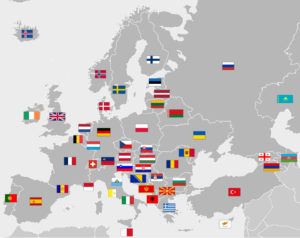
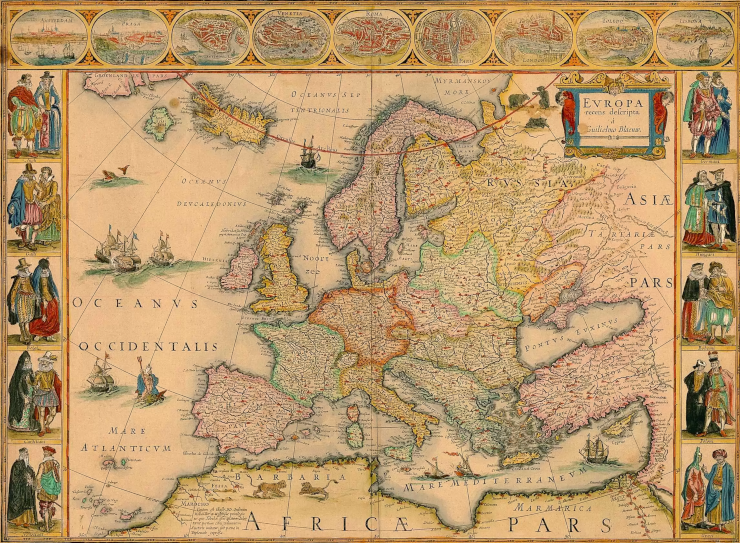
When people talk about the EU, they often use the word Europe instead. This is not just a lapsus. People associate it with the region in the world where they live. The map of Europe has been redrawn many times during its history, often by war and violence (see for example https://brewminate.com/regions-of-europe-and-historical-patterns/). At some point it even reached upto the Ural mountains, now part of Russia and as we witness today, the territorial wars never seem to end. At the same time, Europe is not a monolithic block. The diversity in languages and culture, often with historical roots, is vast.

Continue reading on www.Schuman2030.eu

On federalism and its variants

How can we define “federalism”, “confederalism”, “bounded federalism” and “multi-federalism”? These terms are often used loosely in political discourse, but they have distinct meanings in constitutional theory and practice. Let us define each precisely, then show how they relate to the Schuman2030 proposal.

The verdict:

Schuman2030 concept advocates for a “Bounded Multi-Federal Europe”.

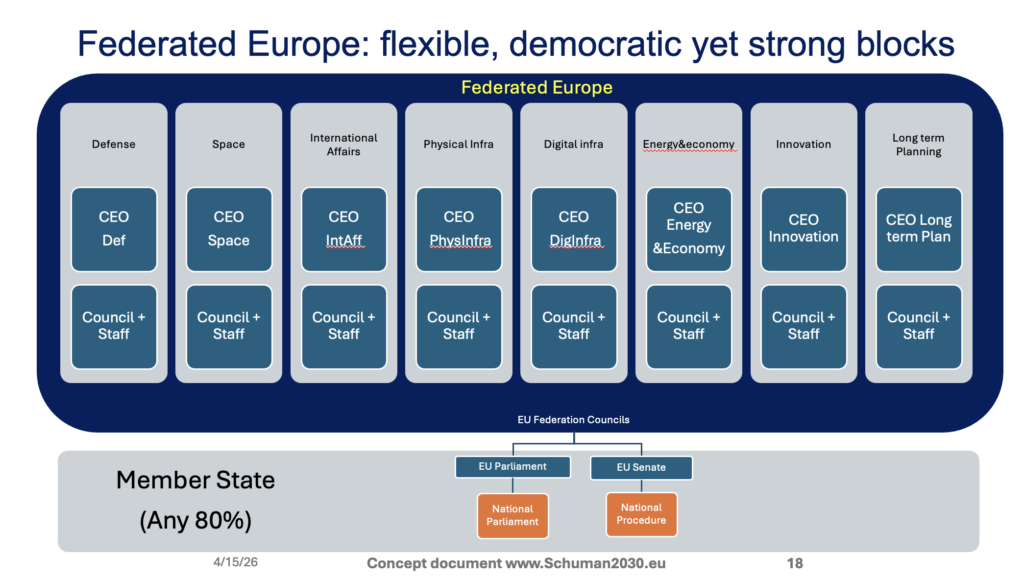
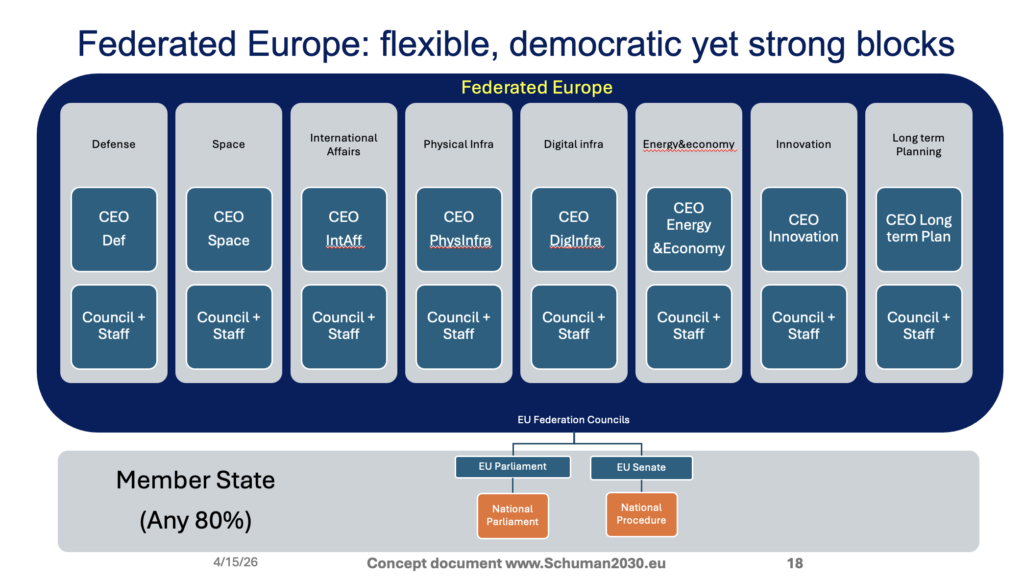
Below a schematic diagram. The new Europe applies a “bottom-up” subsidiarity audit and creates for each supra-national competence domain a Federal Council to which nations can become a member. The unanimity rule is replaced by a general rule to reach 80% consensus for all decisions. For more details see WP6 below.

Continue reading on www.Schuman2030.eu

More details in the WP6 Working Paper

The Schuman2030.eu project was started end of 2025. The approach is to develop a series of Working Papers, starting from how the EU was started and then evolved through a number of treaties, the last one being the Lisbon treaty. From this analysis we are developing a concept for a next Europe. This is Work In Progress and feedback is welcome. Note that Schuman2030 is an apolitical initiative.

Working Papers

The Schuman2030 project is currently reviewing and completing the working papers.

WP1: An in-depth analysis of how Switzerland functions including a comparison with Belgium. Released.

WP2: On the foundation of the European Union from Schuman till today. Released.

WP3: The power structure of the European Union. Released.

WP4: The EU Constitution and the Treaty of Lisbon. Released.

WP6Schuman2030 Post Lisbon reform concept. Released.

WP7: On the Draghi Report. Released.

Blog:

Some relevant and interesting  background readings:

Share the message and share your thoughts

You want a stronger yet more democratic Europe? Share this email with others, provide your feedback and let us know. To join the mailing list click here.


Posted in Uncategorized | Leave a comment

Europe or “European Union”?

When people talk about the EU, they often use the word Europe instead. This is not just a lapsus. People associate it with the region in the world where they life. The map of Europe has been redrawn many times during its history, often by war and violence (see for example https://brewminate.com/regions-of-europe-and-historical-patterns/). At some point it even reached upto the Ural mountains, now part of Russia and as we witness today, the territorial wars never seem to end. At the same time, Europe is not a monolithic block. The diversity in languages and culture, often with historical roots, is vast.

The previous last war on the European continent ended in 1945. In order to avoid a repetition Robert Schuman had the idea to create a common interest based on coal and steel, the two main energy and industrial resources at the time. This was the start of a long period of prosperity. Trade and bilateral economic ties are the best reasons not to go to war. Through successive treaties, European countries created new entities that we now call the European Union, EU for short. The EU is not a territorial concept; it stands for a political organisation to which 27 European countries (at least anno 2026) adhere to. Not all European countries are a member, yet they are part of Europe.

Inspired by the vision of Schuman2030 we advocate for a return to using the term “Europe”, aca. “European”. The concept we developed (see WP6a) is based on Federal Councils whereby European countries unite around specific supra-national competence domains.  It’s a concept of “bounded Federalism” not “centralised Federalism” as often a federal EU is envisioned. Any country in territorial Europa can participate, but doesn’t need to, whereas traditional federalism is an all-inclusive or nothing game. By offering this freedom to European nations, it is easier to create alliances when they make sense. Note that de facto this is already the situation for some European countries who opted not to join the political EU union but nevertheless have trade agreement and cooperate in specific domains. Think about Norway, Switzerland and the UK. It also makes it easier for non-EU members to join a federal Council.

Hence, the reader will gradually see an increasing use of the term European in our texts. The idea emerged as a logical consequence. Europe need to be more united in terms of cooperation and in terms of speaking with a single voice when it matters, yet we have to respect the sovereignty of its family members. This is even urgent. Europe needs to rethink its future. Technology has changed a lot in an increasingly connected and global world since coal and steel were dominant. Strength is created by embracing complementary diversity yet by mutual support when needed.


Posted in Uncategorized | Leave a comment

WP7- On the Draghi Report


Hereby the first DRAFT release (V.1.1) of the Working Paper 7 on the Draghi report.

English version: WP7_The_Draghi_Report_v1_EN

Dutch (Nederlands) versie: WP7_The_Draghi_Report_v1_NL

Summary:

The Draghi Report (officially titled “The Future of European Competitiveness”) is a landmark economic strategy released in September 2024. Commissioned by the European Commission and authored by Mario Draghi, the former President of the European Central Bank and former Prime Minister of Ital, it serves as a high-stakes “wake-up call” for the European Union.

The report argues that Europe faces an “existential challenge” and must undergo a radical transformation to avoid a “slow agony” of economic decline when compared to the United States and China.

We analyse his speech and the report (Part A and Part B with the recommendations and put it next to the concept for reform put forward by Schuman2030.

Samenvatting:

Het Draghi-rapport (officieel getiteld “De toekomst van het Europese concurrentievermogen”) is een baanbrekende economische strategie die in september 2024 is gepubliceerd. Het rapport, in opdracht van de Europese Commissie en geschreven door Mario Draghi, voormalig president van de Europese Centrale Bank en voormalig premier van Italië, dient als een belangrijke waarschuwing voor de Europese Unie.

Het rapport stelt dat Europa voor een “existentiële uitdaging” staat en een radicale transformatie moet ondergaan om een “langzame, pijnlijke” economische achteruitgang te voorkomen, ten opzichte van de Verenigde Staten en China.

We analyseren zijn toespraak en het rapport (deel A en deel B met de aanbevelingen) en vergelijken dit met het hervormingsconcept van Schuman2030.

Posted in Uncategorized | Leave a comment

Micro reforms of Lisbon Treaty

The paper titled “Five Surgical Strikes on the Treaties of the European Union” published by the  European Papers journal proposes five key amendments aimed at overcoming constitutional stalemate within the EU and enhancing its decision-making efficacy. The authors highlight the challenges facing the EU’s treaties regarding unity, operational effectiveness, and responsiveness to changing geopolitical realities.

https://www.europeanpapers.eu/europeanforum/five-surgical-strikes-on-treaties-of-european-union

Abstract: If there is not to be a Convention to revise the Treaty of Lisbon, here is a proposal to amend some key articles in order to strengthen the democratic legitimacy of the EU, to make its decision making more agile, and to enhance its capacity to act.

Summary

The central thesis of the paper is that the current treaties of the European Union are inadequate in addressing the complexities and demands of contemporary governance within the Union. The proposed amendments are categorized into five specific areas:

  1. Decision-making processes: The paper emphasizes the need for streamlined decision-making procedures that can better accommodate the growing membership and diverse interests within the Union.
  2. Competence issues: A realignment of competences is recommended to ensure that the distribution of powers between the EU and member states reflects modern realities and allows the Union to act more decisively.
  3. Enhanced cooperation: The authors suggest mechanisms to facilitate enhanced cooperation among member states, which would enable a more united approach to shared challenges without requiring unanimous consent for every action.
  4. Transparency and accountability: Improving the transparency of institutions and processes within the EU is vital to bolstering public trust and ensuring accountability among policymakers.
  5. Crisis response: The paper advocates for creating provisions that enable the EU to respond more effectively to crises, ensuring rapid and coordinated action in times of need.

Analysis

The amendments suggested in the paper are rooted in a deep understanding of the operational difficulties the EU faces, especially in light of recent challenges such as Brexit, migration crises, and international security threats. By calling for reforms that enhance decision-making efficiency and improve accountability, the paper addresses key weaknesses in the current system.

Moreover, the focus on enhanced cooperation among member states acknowledges the reality of a fragmented political landscape where unanimity in decision-making can hinder timely actions. The authors’ recommendations for increased transparency align with contemporary demands for governance that is more open and responsive to citizens’ concerns.

While the proposed amendments seek to strengthen the EU’s capacity to function and respond effectively, they also initiate crucial debates about sovereignty and the balance of power between national and EU entities. This tension is an ongoing issue within the context of European integration, as member states navigate the complexities of ceding power to a central authority while maintaining their national identities and responsibilities.

In conclusion, the paper provides a robust and thought-provoking analysis of how the EU can evolve its legal frameworks to better meet current and future challenges. The suggested amendments represent an important step toward ensuring that the Union remains relevant and capable in an increasingly interconnected world, paving the way for a more integrated Europe that respects the sovereignty of its member states while fostering collective action.

Overview of the key legal principles in EU treaties

The legal principles underpinning the treaties of the European Union (EU) form a foundational aspect of its governance and operational framework. These principles not only guide the interpretation and application of EU law but also ensure adherence to fundamental values and objectives. Below is an overview of the key legal principles enshrined within the EU treaties.

General Principles of EU Law

  1. Legal Certainty

Legal certainty is a fundamental principle in EU law that ensures individuals are able to understand their rights and obligations under the law. This principle promotes clarity and predictability in the legal framework, preventing arbitrary interpretations by authorities. It functions to protect individuals, allowing them to rely on the established rules and regulations of the EU without the fear of sudden changes in legal interpretation

  1. Proportionality

The principle of proportionality dictates that any action taken by EU institutions must not exceed what is necessary to achieve the objectives of the treaties. This principle serves to balance the interference in individual rights against the aims pursued by the EU, ensuring that measures are measured and appropriate to their purpose.

  1. Respect for Fundamental Rights

All EU actions must respect and promote fundamental rights as established in the Charter of Fundamental Rights of the European Union. This principle aligns EU law with international human rights standards, ensuring the protection of individual rights and freedoms across member states.

  1. Equality Before the Law

This principle mandates that all individuals, regardless of nationality or status, are treated equally under EU law. It emphasizes non-discrimination and aims to provide fair treatment to all parties in legal proceedings, fostering a sense of justice and equity within the EU legal framework.

  1. Primacy of EU Law

The principle of primacy dictates that EU law takes precedence over national law. In situations where national legislation conflicts with EU law, the latter prevails. This principle is essential for ensuring uniform application of EU law across member states and for maintaining the integrity of the EU legal order.

  1. Subsidiarity and Proportionality

The principles of subsidiarity and proportionality govern the exercise of competences within the EU. The principle of subsidiary states that the EU should only act where objectives cannot be sufficiently achieved by individual member states. The proportionality principle requires that any EU action must be limited to what is necessary to achieve the objectives of the Union, ensuring a cooperative approach between EU and national levels of governance.

Conclusion

The legal principles embedded in EU treaties are designed to uphold the rule of law, protect individual rights, and facilitate effective governance across member states. These principles ensure that EU law remains a coherent and equitable system that addresses the needs and rights of individuals while promoting the collective interests of the Union as a whole. By adhering to these principles, the EU aims to reinforce its legitimacy and effectiveness within an increasingly complex global landscape.

Addendum on the proportionality and subsidiarity concept in EU law

The principle of proportionality and the principles of subsidiarity play significant roles in the governance of the European Union (EU), ensuring that actions taken either by EU institutions or Member States are appropriate, necessary, and respectful of the competence framework established by European treaties.

1. The Principle of Proportionality

The principle of proportionality is fundamental in EU law, ensuring that any legislative or administrative action does not exceed what is necessary to achieve its objectives. This principle serves as a safeguard against the overreach of EU institutions, compelling them to consider the impact of their decisions on individual rights and interests. Under this principle, any measure taken must be suitable to achieve the intended aim and also must not impose excessive burdens on individuals or entities compared to the pursued objective. Proportionality thus maintains a balance between the EU’s objectives and the rights of its citizens, promoting fair and just governance practices.

The key function of proportionality is to protect individuals and entities from undue interference by EU measures. For instance, when the EU proposes regulations affecting businesses or environmental standards, these measures must be necessary and appropriate to achieve the desired outcomes, ensuring that the least restrictive alternative is considered first. This principle also reflects the EU’s commitment to efficiency and logic in its policy-making processes, reinforcing democratic values within EU governance.

2. The Role of Subsidiarity

The principle of subsidiarity complements proportionality by determining the appropriate level of governance for specific actions within the EU framework. Enshrined in Article 5(3) of the Treaty on European Union (TEU), subsidiarity states that the EU should only act if objectives cannot be sufficiently achieved by Member States at a local, regional, or national level. This principle is particularly significant in shared competencies, where both the EU and Member States can legislate in the same area.

Subsidiarity ensures that decisions are made as closely as possible to the citizens they affect, preserving the idea of local governance and allowing for diversity amongst Member States. For instance, in matters of education or health policy, it respects the autonomy of individual countries, promoting local solutions that cater to national contexts. This principle not only enhances democratic legitimacy but also ensures a more effective governance structure in which EU-level interventions are justified and necessary.

Both the principle of proportionality and subsidiarity serve to reinforce the democratic fabric of the EU, ensuring that governance remains effective, responsive, and accountable to its citizens while respecting their rights and local preferences. These principles are essential in guiding the exercise of competences within the Union, aiming for a balance that respects individual states’ rights while achieving collective goals in the European community.

3. Theory and practice

Evidence suggests that the principles of proportionality and subsidiarity have not always been consistently followed within the European Union (EU). This inconsistency can often be traced back to the vague boundaries defined by treaties regarding the competences of member states and the EU itself.

  1. Vague Competence Boundaries

The treaties provide a framework for the division of competencies, but many areas remain ambiguous, leading to conflicts between EU actions and national sovereignty. The principle of subsidiarity stipulates that the EU should only act if objectives cannot be sufficiently achieved at the national level, but in practice, this boundary is often blurred. For example, the European Court of Justice (ECJ) has sometimes interpreted EU powers broadly, allowing for actions that member states may deem unnecessary or intrusive, which can lead to challenges regarding adherence to the principle of subsidiarity.

  1. Tensions Between Proportionality and Subsidiarity

In many cases, the implementation of EU laws has demonstrated a disconnect between the principle of proportionality and the spirit of subsidiarity. The ECJ’s case law shows instances where legislation has not strictly adhered to proportionality, as measures that impact national interests are pursued without adequately assessing whether less intrusive alternatives could achieve similar outcomes. This incongruence highlights the ongoing struggle within the EU to balance its powers with the principle of local governance envisaged by subsidiarity.

  1. Critiques and Calls for Reform

Critics argue that the lack of clarity in defining competencies has led to overreach by EU institutions, which can undermine the legitimacy of EU governance and create friction with member states. Reports from various institutions have emphasized the need for reform to ensure that the principles of proportionality and subsidiarity are respected and enforced more rigorously within the legislative process.

Thus, while the principles are theoretically vital components of EU governance, their application in real-life scenarios reveals a complex and often contentious relationship between the EU and its member states. Efforts to refine and clarify these principles are ongoing, as the EU seeks to create a more effective and coherent governance framework.

This discussion indicates that there are indeed tensions and inconsistencies in how these principles are applied, stemming from the vague competence definitions within treaties.

Src: Text edited with AI assistance of Monica.


Posted in Uncategorized | Leave a comment

Jack Birner on EU federation

Jack Birner has published a very timely article “The European Union: from common foreign and defence policy to federation? (Chapter 16 in Palgrave Studies in International Relations, 2025). It outlines how the idea of a federalist Europe has roots even before WWII and why it is more than ever necessary. At the same, Birner demonstrates by highlighting the difference in the thinking of Monnet and Hayek. A functional centralist federalism (which is the current state towards teh EU evolves) vs. one where the sovereignty of the nations is reinforcing factor as it stimulates competion yet requires mutial respect). To quote from the paper: The Federal system limits and restrains sovereign power by dividing it, and by assigning to Government only certain defined rights.” (Lord Acton). This is very much along the lines of thinking in the Schuman2030 project.

Available at: https://isonomiaquarterly.com/wp-content/uploads/2025/11/birner-pfwo.pdf

Abstract:

Birner argues that while the EU possesses federalist characteristics, it is not yet a true federation. Using F.A. Hayek’s 1939 blueprint for a federal Europe, the work analyzes modern EU security and external relations to explore paths toward increased political unification. 

Key Aspects 

  • Context: The chapter analyzes the European Union’s development within a shifting global balance of power, where the USA’s influence is contested by China, and the EU holds economic weight comparable to both but lacks equivalent political power.
  • Framework:It utilizes a detailed 1939 federal Europe plan proposed by F.A. Hayek to assess the current and future agenda of the EU, suggesting Hayek’s insights are relevant for enhancing the EU’s democracy.
  • Thesis: The chapter investigates whether the EU’s common foreign and defence policies (CFSP/CSDP) are propelling the union toward a federal structure.
Posted in Uncategorized | Leave a comment