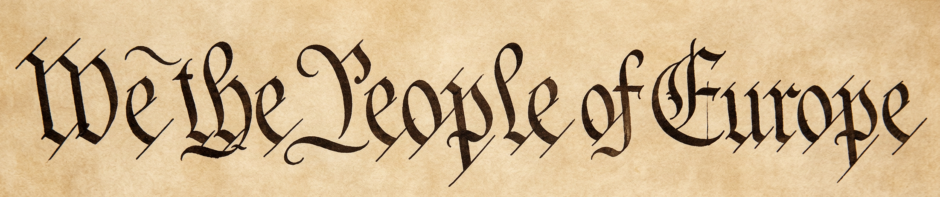
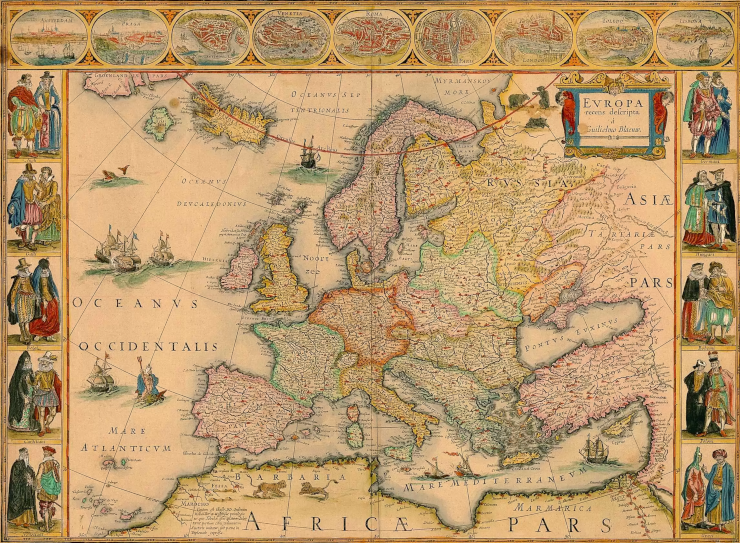
 When people talk about the EU, they often use the word Europe instead. This is not just a lapsus. People associate it with the region in the world where they life. The map of Europe has been redrawn many times during its history, often by war and violence (see for example https://brewminate.com/regions-of-europe-and-historical-patterns/). At some point it even reached upto the Ural mountains, now part of Russia and as we witness today, the territorial wars never seem to end. At the same time, Europe is not a monolithic block. The diversity in languages and culture, often with historical roots, is vast.
The previous last war on the European continent ended in 1945. In order to avoid a repetition Robert Schuman had the idea to create a common interest based on coal and steel, the two main energy and industrial resources at the time. This was the start of a long period of prosperity. Trade and bilateral economic ties are the best reasons not to go to war. Through successive treaties, European countries created new entities that we now call the European Union, EU for short. The EU is not a territorial concept; it stands for a political organisation to which 27 European countries (at least anno 2026) adhere to. Not all European countries are a member, yet they are part of Europe.
Inspired by the vision of Schuman2030 we advocate for a return to using the term “Europe”, aca. “European”. The concept we developed (see WP6a) is based on Federal Councils whereby European countries unite around specific supra-national competence domains. It’s a concept of “bounded Federalism” not “centralised Federalism” as often a federal EU is envisioned. Any country in territorial Europa can participate, but doesn’t need to, whereas traditional federalism is an all-inclusive or nothing game. By offering this freedom to European nations, it is easier to create alliances when they make sense. Note that de facto this is already the situation for some European countries who opted not to join the political EU union but nevertheless have trade agreement and cooperate in specific domains. Think about Norway, Switzerland and the UK. It also makes it easier for non-EU members to join a federal Council.
Hence, the reader will gradually see an increasing use of the term European in our texts. The idea emerged as a logical consequence. Europe need to be more united in terms of cooperation and in terms of speaking with a single voice when it matters, yet we have to respect the sovereignty of its family members. This is even urgent. Europe needs to rethink its future. Technology has changed a lot in an increasingly connected and global world since coal and steel were dominant. Strength is created by embracing complementary diversity yet by mutual support when needed.